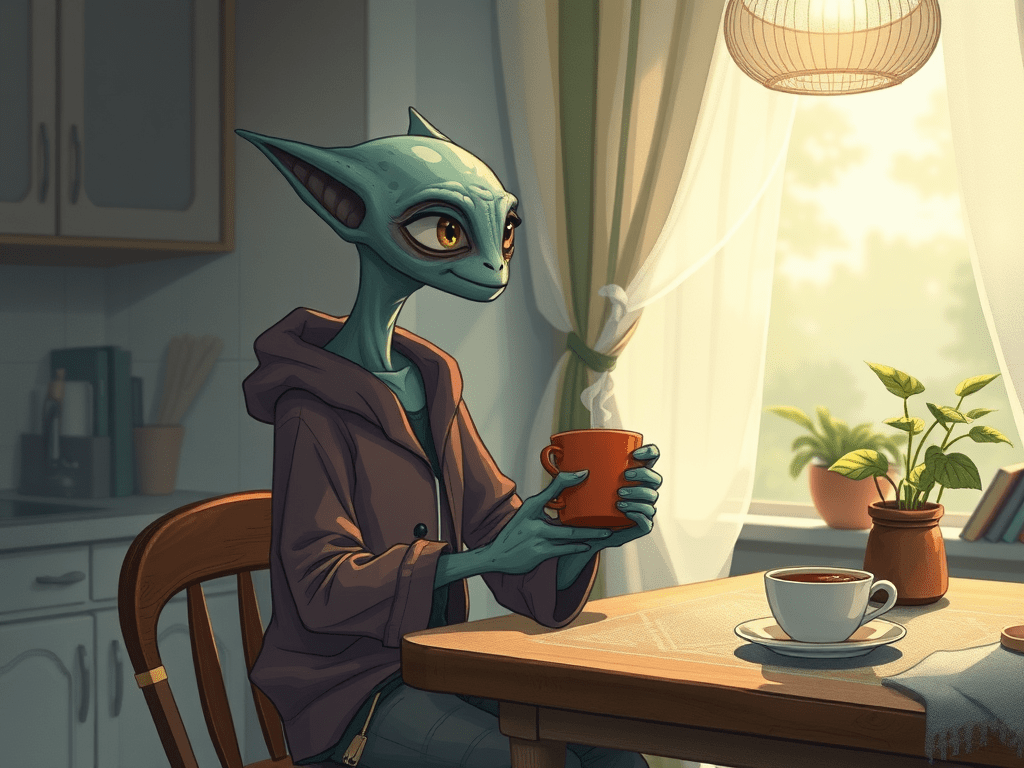
Yo, picture this: you wake up, groggy, maybe a bit grumpy, and you pour that sacred morning coffee. You’re Gloomy, not quite human, maybe an alien, a robot, or some cosmic vibe just passing through. You sip that coffee, stare out the window, and think, “Alright, time to act as if I’m one of these humans.” You put on the mask—smile at the neighbor, nod at the barista, maybe even pretend to care about the weather. But then, something wild happens. After a while, you’re not just acting—you’re feeling it. The mask starts to stick, and suddenly, you’re not just playing human; you’re feeling human. Welcome to Act As If, the heart of my new album, where we explore how faking it till you make it turns into something real, raw, and beautifully messy.
DeepDive Podcast about “Act As If”
The Journey from Acting to Feeling
This philosophical discussion analyzes the concept album Act as if to feel as if, which reinterprets the phrase “fake it till you make it” as a profound path toward becoming truly human. The central idea revolves around the character “Gloomy,” an outsider who begins by purely performing human actions as mimicry, such as pouring coffee or smiling, with no genuine feeling attached. This forced performance creates cognitive dissonance, a conflict between the internal belief of being an emotionless entity and the daily actions of acting human, which the brain resolves by shifting the internal belief to align with the action. This process relies on a “cosmic feedback loop” where consistent external actions create physiological responses and new neural pathways, ultimately transforming the pretense into authentic feeling and achieving energetic sovereignty, a state where one’s internal system is so stable that it avoids external conflict.
So, what’s this whole “Act As If” to “Feel As If” deal? It’s like this: you start by pretending. You go through the motions—say the right things, wear the right clothes, sip that coffee like it’s your lifeline. It’s a performance, a script you follow to blend in with the humans. Maybe you’re mimicking their hustle, their small talk, or their obsession with Wi-Fi passwords. But the longer you play the part, the more it seeps into you. You laugh at a dumb joke, and it feels… good? You tear up at a sad movie, and whoa, what’s that warm fuzz in your chest? That’s the magic shift—
Why does this happen? It’s all about your brain being a sneaky little trickster. See, your mind doesn’t always know the difference between pretending and being. When you act happy, your brain starts firing off happy chemicals like dopamine, even if you’re faking it. It’s called the “fake it till you make it” principle, backed by sciencey stuff like cognitive behavioral therapy. Your actions shape your emotions, like a cosmic feedback loop. Keep smiling, and your brain goes, “Oh, we’re happy now? Cool, let’s roll with it!” Same goes for acting human—you mimic their quirks, and soon enough, you’re feeling their joys, fears, and coffee cravings.
How Long Does the Transformation Take?
Alright, how long before Act As If flips to Feel As If? It’s not like flipping a switch—more like brewing that perfect cup of coffee (takes time, but oh, it’s worth it). For some, it’s quick: a few weeks of pretending to be confident, social, or “human” can spark genuine feelings. Studies (yep, I’m throwing in some nerdy bits) suggest habits take about 21 to 66 days to stick, depending on the person and the vibe. If you’re acting like a human every day—chatting, laughing, maybe even arguing about pineapple on pizza—your brain starts rewiring itself. You might notice the shift in little moments: you catch yourself genuinely caring about someone’s day or feeling a pang of nostalgia when you hear a cheesy pop song.
But it’s not a straight line. Some days, you’re back to feeling like an alien, like the mask is slipping. That’s normal. The transformation can take months, especially if you’re battling doubts or existential crises (who hasn’t?). The key is consistency—keep acting human, and the feelings creep in like a catchy tune you can’t stop humming. For some, it’s a lifelong dance, dipping in and out of Act As If and Feel As If, depending on the day or the coffee’s strength.
The Pros and Cons of Acting As If
Let’s break it down—what’s awesome about Act As If, and what’s kinda meh?
Pros of Act As If:
- Blending in like a pro: Acting human helps you navigate the world without raising eyebrows. Nobody’s gonna question your cosmic origins if you’re nailing small talk about the weather.
- Boosts confidence: Faking it gives you a head start. Pretend you’re a social butterfly, and doors open—new friends, opportunities, maybe even a date.
- Kickstarts change: Acting like you’ve got it together can trick your brain into actually getting it together. It’s like a shortcut to growth.
- Fun and playful: There’s something cheeky about playing human. You get to experiment, try on different vibes, and see what sticks.
Cons of Act As If:
- It’s exhausting: Keeping up the act can drain you, especially if you’re pretending to be something you’re not deep down. Masks get heavy.
- Feels fake: If you’re acting too far from your truth, it can feel like you’re lying to yourself. Nobody wants to be a full-time impostor.
- Risk of disconnect: You might lose touch with who you really are, especially if you’re acting for others’ approval instead of your own growth.
The Pros and Cons of Feeling As If
Now, when Act As If becomes Feel As If, it’s a whole new game. Here’s the scoop:
Pros of Feel As If:
- It’s real, baby: Feeling human means you’re not just playing a role—you’re living it. The joy, the pain, the weird obsession with memes? It’s all yours.
- Deeper connections: When you feel human, your relationships get richer. You’re not just nodding along; you’re actually there, sharing laughs and tears.
- Personal growth: Feeling the human experience helps you grow in ways acting never could. You learn empathy, resilience, and how to handle life’s chaos.
- Inner peace: There’s a calm that comes with authenticity. No more pretending—just being, flaws and all.
Cons of Feel As If:
- Vulnerability overload: Feeling human means opening up to the messy stuff—heartbreak, fear, existential dread. It’s not always fun.
- Loss of control: When you’re fully in the human vibe, you can’t just switch it off. You’re stuck feeling the highs and the lows, no escape hatch.
- Identity crisis: If you were comfy as a cosmic outsider, feeling human might make you question who you are. Are you still Gloomy, or just another coffee-drinking mortal?
Why It Works and Why It Matters
So, why does Act As If turn into Feel As If? It’s like your brain’s a DJ, remixing your reality. When you act a certain way, you’re laying down tracks for your mind to follow. Over time, those tracks become your vibe, your truth. It’s not just psychology—it’s almost spiritual. You’re co-creating your reality, one fake smile or genuine laugh at a time. For Gloomy – Act As If, this is the core of the album: the playful pretense of being human, the slow melt into feeling it, and the wild, messy beauty of that transformation.
The shift matters because it’s about becoming. Whether you’re an alien, a robot, or just a human who feels out of place, Act As If is a reminder that you can shape who you are. You start by pretending, but you end up discovering. The album’s tracks will take you through this journey—some playful, some raw, all vibing with the idea that faking it can lead to finding it.
Wrapping It Up
Act As If to Feel As If is the heartbeat of Gloomy – Act As If. It’s about the morning coffee, the awkward small talk, the moments you pretend to fit in, and the magic when you realize you do fit in—or at least, you feel like you do. It’s a dance between pretending and being, a cosmic wink at the human condition. The transformation can take weeks, months, or a lifetime, but it’s worth every step. So, grab your coffee, put on the album, and let’s play human together—until we’re not just acting, but feeling it, too. ✨
 Message From One
3 thoughts on “Act As If to Feel As If: The Gloomy Guide to Playing Human”