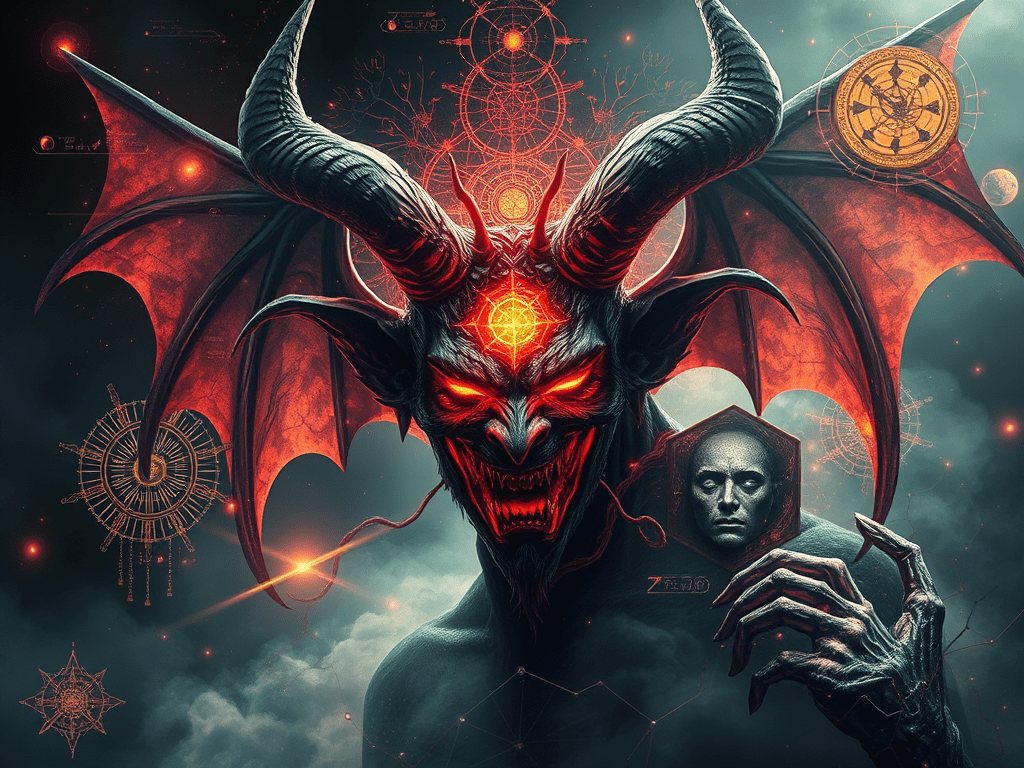
The concept of demons has persisted across cultures and epochs, often embodying fear, chaos, or moral struggle. In the context of a modern, integrative worldview—termed “2.0 Philosophy”—demons are reinterpreted as multifaceted phenomena that encompass psychological, symbolic, and metaphysical dimensions. This paper explores how demons can be understood within 2.0 Philosophy, a framework that synthesizes scientific rigor, psychological insight, spiritual wisdom, and practical application. By examining demons as internal conflicts, archetypal symbols, and potential metaphysical entities, this paper provides a holistic understanding of their role in human experience and offers actionable strategies for addressing them in contemporary life.

Introduction
The term “demon” evokes a range of interpretations, from malevolent supernatural beings in religious traditions to metaphorical representations of personal or societal struggles. In a 2.0 Philosophy, which we define as a modern, holistic worldview integrating neuroscience, psychology, spirituality, and technology, demons are neither dismissed as superstition nor uncritically accepted as literal entities. Instead, they are analyzed as dynamic constructs that reflect the complexities of human consciousness and existence. This paper aims to elucidate what humans need to know about demons within this framework, addressing their psychological origins, symbolic significance, metaphysical possibilities, and practical management.
- Defining 2.0 Philosophy
2.0 Philosophy is a hypothetical, integrative framework that responds to the challenges of modern existence. It combines:
Scientific Inquiry: Insights from neuroscience, psychology, and cognitive science to understand human behavior and consciousness.
Spiritual Wisdom: Elements from mystical, religious, and philosophical traditions that explore meaning and transcendence.
Technological Integration: The use of modern tools, such as mindfulness apps, biofeedback, or data-driven self-analysis, to enhance self-awareness and growth.
Pragmatic Application: Actionable strategies for self-actualization, resilience, and navigating societal complexities.
This philosophy assumes that humans are multidimensional beings, shaped by biology, culture, and existential questions, and it seeks to provide a balanced approach to understanding phenomena like demons in a way that is both intellectually rigorous and practically relevant.
- Psychological Interpretation of Demons
2.1 Demons as Internal Conflicts
In psychological terms, demons can be understood as manifestations of the unconscious mind. Carl Jung’s concept of the “shadow”—the repressed or unacknowledged aspects of the self—offers a useful lens. Demons may represent:
Unresolved Trauma: Past experiences that manifest as anxiety, fear, or self-destructive behaviors.
Negative Thought Patterns: Cognitive distortions, such as catastrophizing or self-criticism, that undermine mental well-being.
Repressed Desires: Impulses or emotions that conflict with one’s conscious values, creating inner turmoil.
For example, an individual struggling with addiction might perceive their compulsion as a “demon” that exerts control over their actions. In 2.0 Philosophy, this is not merely a metaphor but a call to engage with the unconscious through evidence-based practices like cognitive-behavioral therapy (CBT) or mindfulness.
2.2 Neuroscience of Demons
Neuroscience provides further insight into why demons feel so real. The amygdala, responsible for processing fear and threat, can amplify perceived dangers, giving internal struggles an almost external, malevolent quality. Similarly, the default mode network (DMN), which governs self-referential thought, can perpetuate negative rumination, making demons appear as persistent, autonomous forces. In a 2.0 framework, understanding these neural mechanisms empowers individuals to reframe demons as manageable brain-based phenomena.
2.3 Practical Tools
To address psychological demons, 2.0 Philosophy advocates:
Mindfulness Meditation: To observe and detach from negative thought patterns.
Journaling: To externalize and analyze internal conflicts.
Therapeutic Interventions: Techniques like CBT or Jungian shadow work to integrate repressed aspects of the self.
Biofeedback Technologies: Wearable devices or apps that monitor physiological states, helping individuals regulate stress responses.
- Symbolic Interpretation of Demons
3.1 Demons as Archetypes
From a mythological perspective, demons are archetypal symbols found across cultures, representing chaos, temptation, or the “other.” Joseph Campbell’s work on the hero’s journey highlights demons as adversaries that test the protagonist’s resolve, symbolizing the universal struggle between order and chaos. In 2.0 Philosophy, demons are not external enemies but mirrors reflecting internal or societal disharmony.
3.2 Cultural and Social Demons
Demons can also symbolize collective fears or societal pressures. For instance:
Cultural Narratives: Media-driven fears, such as apocalyptic scenarios or social division, can manifest as collective demons.
Systemic Issues: Inequality, injustice, or environmental crises may be perceived as demonic forces that threaten human flourishing.
In a 2.0 context, these symbolic demons are opportunities for growth. By confronting them, individuals and societies can clarify values, foster resilience, and drive meaningful change.
3.3 Practical Tools
To engage with symbolic demons, 2.0 Philosophy suggests:
Narrative Reframing: Reinterpreting challenges as opportunities for growth, akin to the hero’s journey.
Community Dialogue: Engaging in collective discussions to address societal demons, such as through forums or social media platforms like X.
Creative Expression: Using art, writing, or music to process and transform symbolic demons into sources of inspiration.
- Metaphysical Interpretation of Demons
4.1 Demons as Energetic Entities
For those open to metaphysical perspectives, demons may be conceptualized as non-physical entities or energies. In esoteric traditions, demons are sometimes seen as manifestations of negative energetic frequencies, whether personal (e.g., anger, fear) or collective (e.g., societal discord). In 2.0 Philosophy, this view is neither endorsed nor dismissed but explored as a hypothesis that complements scientific inquiry.
4.2 Existential Forces
Demons may also represent universal forces of entropy or destruction, challenging humans to find meaning in a chaotic universe. Philosophers like Nietzsche, who spoke of confronting the “abyss,” align with this view, suggesting that demons test our capacity for resilience and self-overcoming.
4.3 Practical Tools
To address metaphysical demons, 2.0 Philosophy proposes:
Energy Work: Practices like meditation, yoga, or reiki to align personal energy with positive frequencies.
Ritual and Symbolism: Creating personal rituals to confront and transform perceived negative energies.
Philosophical Inquiry: Reflecting on existential questions to find meaning in the face of chaos, using frameworks like existentialism or stoicism.
- A Unified Approach: Addressing Demons in 2.0 Philosophy
2.0 Philosophy integrates these perspectives into a practical, four-step process for addressing demons:
Identification: Recognize the demon, whether it’s a psychological pattern, symbolic archetype, or perceived metaphysical force. Tools like journaling or meditation can aid this process.
Analysis: Use a blend of rational (e.g., cognitive analysis) and intuitive (e.g., dream work, spiritual reflection) methods to understand the demon’s origins and impact.
Transformation: Convert the demon’s energy into a constructive force through therapy, creative expression, or spiritual practice. For example, a fear of failure might be transformed into motivation for growth.
Prevention: Build habits to minimize future demonic influences, such as regular mindfulness practice, community engagement, or technological tools like habit-tracking apps.
- Case Study: Applying 2.0 Philosophy to a Personal Demon
Consider an individual struggling with self-doubt, which they describe as a “demon” undermining their confidence. In 2.0 Philosophy:
Psychological Approach: They use CBT to identify cognitive distortions and journal to explore the roots of their self-doubt, possibly tied to past criticism.
Symbolic Approach: They view self-doubt as an archetypal “trickster,” challenging them to grow in resilience. They reframe it as a teacher rather than an enemy.
Metaphysical Approach: They practice meditation to align their energy, visualizing self-doubt dissolving into confidence.
Outcome: Through integrated practices, the individual transforms self-doubt into a source of motivation, using tools like a mindfulness app to sustain progress.
- Conclusion
In 2.0 Philosophy, demons are not external monsters but multifaceted phenomena that reflect the complexities of human existence. Whether viewed as psychological conflicts, symbolic archetypes, or metaphysical energies, demons offer opportunities for growth, self-awareness, and transformation. By integrating scientific, spiritual, and practical tools, 2.0 Philosophy provides a comprehensive framework for understanding and addressing demons in a way that empowers individuals and societies to thrive in the modern world.
References
Jung, C. G. (1959). The Archetypes and the Collective Unconscious. Princeton University Press.
Campbell, J. (1949). The Hero with a Thousand Faces. Pantheon Books.
Nietzsche, F. (1883). Thus Spoke Zarathustra. Penguin Classics.
Kabat-Zinn, J. (1990). Full Catastrophe Living: Using the Wisdom of Your Body and Mind to Face Stress, Pain, and Illness. Delta.
 Message From One