Introduction
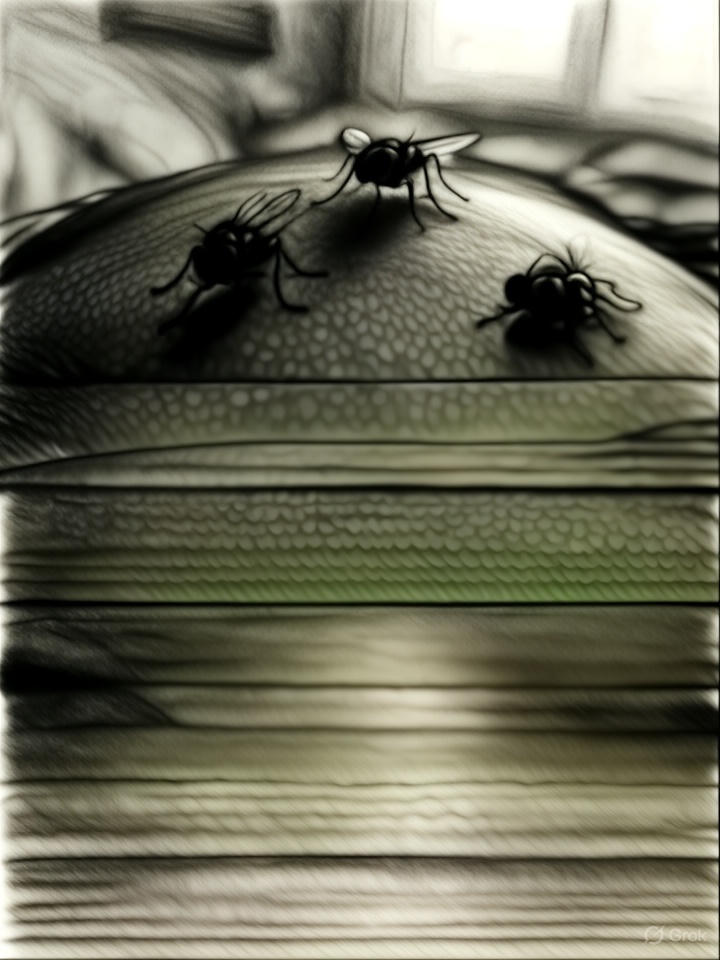
This paper begins with a mundane, almost laughable observation: each time I kill a fly, a second fly inevitably lands on my head. Over the years, this has transformed from an annoyance into a recurring existential riddle, a strange echo that seems too punctual to be mere coincidence. What at first appears trivial or accidental becomes, through repetition, a pattern that demands reflection. What are these flies? What do they signify? And above all, who or what is orchestrating their choreography?
We will explore this phenomenon through three interpretative lenses: metaphysical, techno-psychological (‘2.0’), and solipsistic. Notably, we will push solipsism beyond the cliché of a single dreaming mind and entertain a broader view: a world inhabited by multiple solipsists, each radiating their own version of reality, each locked in overlapping subjective dimensions. Within this context, the second fly is never just a fly , it becomes the convergence point of perception, guilt, projection, and perhaps even cosmological law.
1. Metaphysical Interpretation: The Fly as Energetic Echo
Within a metaphysical framework, the arrival of the second fly can be seen as a manifestation of balance or karmic realignment. The act of killing, even something as seemingly insignificant as a fly, produces a rupture in the ethical or energetic field of the agent. The new fly is not punishment, but correction: a return to symmetry.
In various spiritual traditions, every creature is part of an interconnected web of life. To kill one node is to disturb the entire structure. Thus, the second fly appears as a subtle counterbalance, an echo not in sound, but in being. It is the world whispering: “You have disturbed the stillness; now something must respond.”
2. The 2.0 Explanation: Conditioning, Chemistry, and Cognitive Feedback Loops
From a contemporary, techno-psychological perspective, the so-called “2.0 explanation”, we turn to the interplay between the mind, the body, and the environment. Human brains are hardwired to detect patterns and assign causality, even where none exists. Each time a fly lands on the head after another has been killed, the event is logged in memory as confirmation of a “law.” Over time, the pattern becomes self-reinforcing.
But this may not be entirely imaginary. There are plausible biological factors at work. Killing a fly might release scent molecules, vibrations, or chemical signals that attract other flies. The tiny seismic tremor of a slap, or the heat of the body, could alert others nearby. In this reading, the second fly is both a physical consequence and a psychological construct, a hybrid event in which body, environment, and mind collaborate to sustain a symbol.
3. Solipsism: The Fly as Mirror of Inner Repercussion
In a solipsistic model of reality, the external world is a projection of one’s inner state. The first fly’s death is not a mere act of hygiene or control, but an eruption, an assertion of irritation, dominance, or rejection. The second fly, then, is not an outsider but a boomerang of internal response. It is not on your head : it is from your head.
Viewed this way, the fly becomes a messenger of the Self: a minor but insistent moral reminder, fluttering at the edge of your awareness. In solipsistic logic, there is no “other.” The fly is you, reminding you that you struck without understanding. It is guilt rendered as insect.
But let us push this even further. In a world where each solipsist generates their own partially overlapping dimension, the second fly might not even be your creation. It may be an intersection point, a collision of subjective timelines, where one self’s regret meets another self’s vengeance. The fly becomes entangled with our shared dreamscapes, buzzing at the border of identity and responsibility.
Conclusion
Whether understood as karmic feedback, neurocognitive conditioning, or solipsistic projection, the second fly is never just a fly. It is a signal, a gesture, a question. It invites us not to swat, but to attend. To pause.
And in that pause, something shifts. The banal becomes significant. The room grows quiet. A dead insect on a windowsill opens a door to insight, to listening — to the recognition that perception itself is not passive, but generative. The buzzing becomes resonant, no longer random but rhythmically aligned with some deeper pattern, a pattern written not just by the world, but by the perceiver of the world.
In that space, we are not alone. We are swarms of one, dreaming realities that touch in fleeting, flickering synchrony.
 Message From One