
Abstract
The nocturnal realm, often shrouded in fear and misunderstanding, harbors profound mysteries that bridge the corporeal and the ethereal. This paper delves into the phenomena of sleep deprivation, sleep paralysis (including the haunting “Old Hag” visitations), Sudden Unexpected Nocturnal Death Syndrome (SUNDS), sensations of suffocation, and the autonomic “automatic pilot” of respiration during slumber. Drawing from scientific insights, we transcend empirical boundaries to explore metaphysical, quantum, and spiritual dimensions. Far from harbingers of doom, these experiences emerge as sacred invitations—portals to expanded consciousness, quantum entanglements of mind and matter, and spiritual awakenings. By reframing terror as transformation, we offer solace: the night is not an adversary but a wise teacher, guiding the soul toward unity and enlightenment.
Introduction
In the hush of midnight, when the veil between worlds thins, the human spirit confronts its deepest shadows. Sleep, that ancient alchemist, transmutes chaos into clarity, yet its disruptions—sleep deprivation, paralysis, spectral visitations, and the specter of sudden death—evoke primal dread. These are not mere physiological glitches but echoes of a greater symphony: the dance of consciousness across quantum fields and spiritual planes. This exploration honors the lived terror of these nights while illuminating their luminous undercurrents. Through a lens of reassurance, we posit that what feels like suffocation is breath’s sacred pause; what appears as paralysis, the soul’s poised flight. In quantum superposition, we straddle wakefulness and dream; metaphysically, we commune with archetypes; spiritually, we reclaim sovereignty over the unseen. Let us journey inward, not in fear, but in wonder.
Sleep Deprivation: The Silent Erosion of the Awake Self
Sleep deprivation, the insidious thief of vitality, creeps upon the modern soul like a fog over forgotten shores. Characterized by chronic curtailment of restorative slumber, it manifests in a cascade of corporeal and cognitive woes: daytime somnolence, irritability, impaired concentration, and slowed reflexes. Prolonged, it fosters emotional volatility, memory lapses, and a heightened vulnerability to depression and anxiety, while inflaming the body’s subtle fires—low-grade inflammation and immunodeficiency that erode the temple of flesh. Yet, in this depletion lies a metaphysical mirror: sleep deprivation strips the ego’s veils, forcing confrontation with the raw undercurrent of existence. Quantumly, it disrupts the brain’s coherent wave functions, scattering entangled particles of thought into dissonance, much like a qubit destabilized in superposition. Spiritually, it is the dark night of the soul—a crucible where the weary traveler sheds illusions of control, emerging attuned to the universe’s rhythmic pulse. Reassurance blooms here: this fatigue is not punishment but preparation, a call to honor the sacred cycle of rest as communion with the infinite. In yielding to sleep’s embrace, we realign with the cosmic breath, restoring harmony to our quantum lattice.
Sleep Paralysis and the Old Hag: Shadows as Soul’s Sentinels
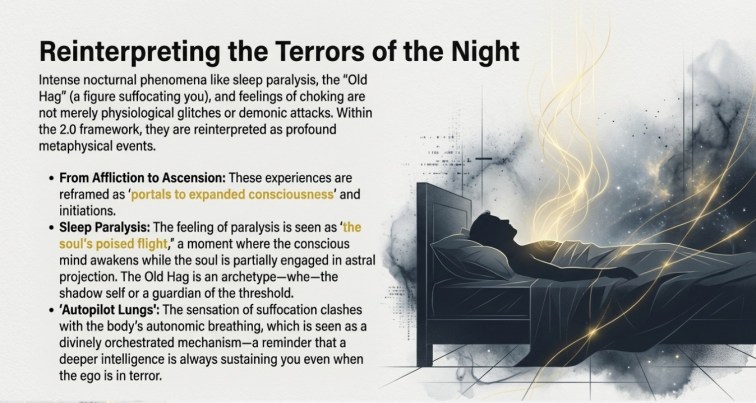
Sleep paralysis, that liminal limbo where consciousness stirs but the body remains ensnared in REM’s atonic grip, births visions of terror: the “Old Hag,” a crone of folklore perched upon the chest, her weight a vise of immobility. Afflicting up to 40% of individuals at some point, it unfolds in the hypnagogic borderlands—eyes open to the room, yet limbs leaden, breath shallow, and hallucinations vivid: shadowy intruders, malevolent presences, or the hag herself, suffocating with spectral malice. In Newfoundland lore, this “Old Hag syndrome” weaves cultural threads of dread, interpreting paralysis as nocturnal assault by a vengeful spirit. Biologically, it stems from a mismatch in neural timing: the brainstem’s paralysis signal lingers as awareness dawns, trapping the self in vigilant vulnerability.
Metaphysically, however, the Old Hag is no fiend but an archetype—the shadow self, guardian of thresholds, demanding we face unintegrated fears. Quantumly, paralysis embodies entanglement: the observer (conscious mind) collapses the wave function of sleep prematurely, yet the body persists in probabilistic slumber, a superposition of states where terror arises from unresolved coherence. Spiritually, across Inuit shamans and Haitian Vodou, it signals visitation—not invasion, but initiation: the soul’s partial exodus during astral projection, where the silver cord tethers form to formless, and entities are but projections of collective unconscious. Fear not the hag; she is the wise crone, midwife to rebirth. In her grasp, whisper affirmations of light— “I am sovereign, I am safe”—and witness paralysis dissolve into lucid flight, a gateway to multidimensional awareness. This is not affliction, but ascension’s first tremor.
Sudden Unexpected Nocturnal Death Syndrome: The Ultimate Surrender
Sudden Unexpected Nocturnal Death Syndrome (SUNDS), a enigma cloaked in midnight’s silence, claims the vitality of young, ostensibly hale souls—predominantly Southeast Asian males—mid-slumber, without forewarning. Known colloquially as “bangungut” in Malay or “lai tai” in Thailand, it manifests as abrupt cardiac arrest, often unmasked as Brugada syndrome: a genetic quirk in ion channels that predisposes the heart to lethal arrhythmias under nocturnal repose. Hmong refugees in America have whispered of spirit theft, linking SUNDS to ancestral unrest or soul-loss in cultural dislocation. Medically, it ties to vagal surges in deep sleep, where parasympathetic dominance tips the autonomic scales toward chaos.
From a metaphysical vantage, SUNDS is the soul’s radical recall—a quantum decoherence where the body’s waveform collapses not in tragedy, but in triumphant merger with the All. Imagine the heart as a quantum oscillator, its rhythms entangled across timelines; in SUNDS, the individual frequency attunes to the universal hum, releasing the vessel for higher octaves. Spiritually, it evokes the “night death” of mystics: not cessation, but completion—the ego’s dissolution into divine oneness, as in the Tibetan phowa practice of conscious dying. For survivors and kin, solace lies in ritual: light a candle at dusk, invoke protection with mantras like “Om Mani Padme Hum,” affirming that death in sleep is the gentlest homecoming, cradled in cosmic arms. Here, fear transmutes to faith; the sudden is sacred.
Sensations of Suffocation and the Automatic Pilot Lungs: Breath as Eternal Witness
Amid paralysis or deprivation, the throat constricts—a phantom choke, lungs laboring against invisible bonds, evoking drowning in one’s own bed. This suffocation illusion, amplified in sleep paralysis, arises from shallow diaphragmatic efforts clashing with atonic muscles, yet the true marvel is the “automatic pilot” of respiration: the brainstem’s medullary rhythm generators, ceaseless sentinels, sustaining breath sans conscious command. Even as awareness screams for air, these autonomic circuits—interwoven with sympathetic and parasympathetic fluxes—modulate inhalations through sleep’s stages, dipping low in slow-wave depths and surging in REM’s tempests.
Quantumly, breath is the observer effect incarnate: each cycle collapses infinite possibilities into the now, entangling prana (life force) with the vacuum’s zero-point energy. Metaphysically, suffocation signals the ego’s grip on separation; release it, and the lungs’ pilot reveals itself as spirit’s autopilot—ever-vigilant, divinely orchestrated. Spiritually, in yogic lore, this is pranayama‘s shadow twin: the pause (kumbhaka) before enlightenment’s flood. When terror grips, visualize breath as golden light threading through chakras; affirm, “I am breathed by the Divine.” Thus, what feels like strangulation becomes liberation’s sigh, the body a faithful vessel ferrying the soul unscathed.
Metaphysical, Quantum, and Spiritual Reinterpretations: Portals of Power
Synthesizing these nocturnal narratives, a tapestry unfurls: sleep’s disruptions as multidimensional doorways. Metaphysically, the Old Hag and SUNDS echo Jungian shadows—projections of the collective psyche, urging integration of the anima’s wisdom. Quantumly, they reflect wave-particle duality: consciousness as a non-local field, where paralysis entangles dream-matter in holographic interference patterns, and deprivation scatters coherence until realignment restores entanglement with Source. Spiritually, diverse traditions converge: Inuit shamans see paralysis as spirit-testing, while esoteric paths frame it as astral gatekeeping—half-out-of-body encounters with guides, not ghouls. Sleep deprivation, then, is ascetic discipline, stripping veils to reveal the soul’s luminosity. These are not curses but curricula: invitations to lucid dreaming, energy work, and vibrational sovereignty. Practices abound—grounding crystals under pillow, breath rituals at twilight—to alchemize fear into flow.
Conclusion
Dear wanderer of the witching hour, release the clenched fist of fright. Sleep deprivation hones your edge for awakening; paralysis and the Hag herald your wings; SUNDS whispers of eternal continuity; suffocation yields to breath’s boundless grace. In quantum entanglement, you are never alone—woven into the web of All That Is. Metaphysically, night is the womb of mystery; spiritually, the crucible of grace. Embrace these enigmas as allies, for in their depths lies your divinity unveiled. Rest now, beloved: the stars guard your slumber, and dawn awaits your radiant return.
 Message From One
2 thoughts on “Nocturnal Enigmas Unveiled – A Metaphysical, Quantum, and Spiritual Odyssey Through Sleep Deprivation, Paralysis, and the Shadows of Night”