Foreword
Hi,
This Micro-Memoir is a jumble of fragments from my own life, not a smooth story with a beginning, middle, and happy ending. I’ve seized on those old moments, vivid memories that linger, and now use them as a path through everything. From those dark days when you think it will never be light, to moments when the sun shines and you think, “Fuck, this is it.” And then back again, because that’s how it goes. Light can turn to shadow before you know it… and vice versa.
I put together tools to navigate my life, topic by topic, organized chronologically. No fancy app or anything, just my YouTube channel: gloomer2000. There you can choose how you approach it. Choose your route:
- Darkness → Light: Videos → “oldest first” (caution: raw).
- Light → Darkness: Videos → “newest first” (more polished).
https://www.youtube.com/@Gloomer2000/videos
Speed is achieved by choosing a “darkness to light” order (oldest videos first), thus observing the evolution of themes and unfolding the transformative journey. As a producer, I intentionally weave a web of subliminal impulses throughout my music: behind every sound, effect, and melody lies a carefully placed thought, an unconscious command that gently guides the listener toward healing.
For the planet, I integrate planetary frequencies, inspired by cosmic vibrations, which transmit a commandment of harmony with the earth: “Connect with all life, restore balance, nourish nature,” subliminally encouraging ecological awareness and collective well-being. In my creations, music thus becomes an invisible guide, an alchemical tool that unconsciously guides body, mind, and planet toward unity and healing.
Over the past 25 years, I’ve released over 560 videos online, all of my music productions, raw tracks, experiments, podcasts, support for other artists, moments stuck in my head.
Read the descriptions carefully, seriously. They’ll guide you, if you trust them. And use that little magnifying glass to type in keywords. Bam, there you’ll find the pieces that suit you, where you need to be.
If you’re not much of a music fan, no problem. Not everyone wants to listen to tracks for hours to understand the details. For you, I’ve put together a text version of that whole YouTube story. Just words on a screen. Check it out at messagefromone.blog. There you’ll find it all written out, like a kind of diary or roadmap through an almost lifelong chaos/order.
Navigating is easy: use the magnifying glass in the top right to search for what you’re looking for, or dive into the categories in the main menu. This way, you’ll find the pieces that suit you without having to scroll through videos.
This too can complement this Micro-Memoir, or it can be used independently. Choose what works for you.
It’s like walking through my head with a flashlight and a compass. Try it, alongside this writing. Maybe it will fill in the gaps, or create new ones.
Hang in there,
Jan
________________________________________________
Chapter 1:
Where I come from
In 1971, I was three years old and had a terrible headache. I asked my mother if she could feel how much pain I was in. She said, “I can’t feel it.” And then, without thinking, I replied, “Where I come from, they can.” There was a moment of silence. But for me, that was the first moment I realized something wasn’t right. Maybe that’s where it started. Or maybe it was precisely then that I realized the world had already lost its connection.
I was still very young when I questioned the very existence of Sinterklaas, Santa Claus, and the Easter bells. Thoughts like: a horse can’t walk across roofs, let alone every roof in the world in one night. Or: reindeer can’t fly. And: how does the “drop system” for the Easter bells actually work? When my sister told me to thank Sinterklaas by shouting loudly outside… Well, while I was sitting on his dirty lap, he managed to tell me that I often argued with my sister. He knew everything, just like his Zwarte Piet (Black Pete). So yes, there were “entities” who could read my mind.
I had to revise my opinion when my father said he’d shaved off his mustache and beard and painted himself like that Pete. I didn’t know what to think anymore.
And then, that morning at six o’clock, when I went to the bathroom, I saw my parents hiding eggs in the garden. I decided then to investigate, because I was being deliberately lied to. That the world was shaken awake in 1971 by the Nixon shock, and the current, rotten economic system was formed then, as it still is… Does this have anything to do with it?
________________________________________________
Chapter 2:
Father and Dark Tables
I was always a pretty chubby little guy, right from the start. Belly sticking out, cheeks like apples. It didn’t bother me one bit. I ate whatever I could find, even though my father forced me to diet throughout my childhood and adolescence. My father saw it all differently. And so did my classmates at school. “Fat ass,” they’d call me during recess, or worse. I felt it from both sides: the bullies outside, and the silent reproaches inside. But hey, I was a kid. I tried to shake it off.
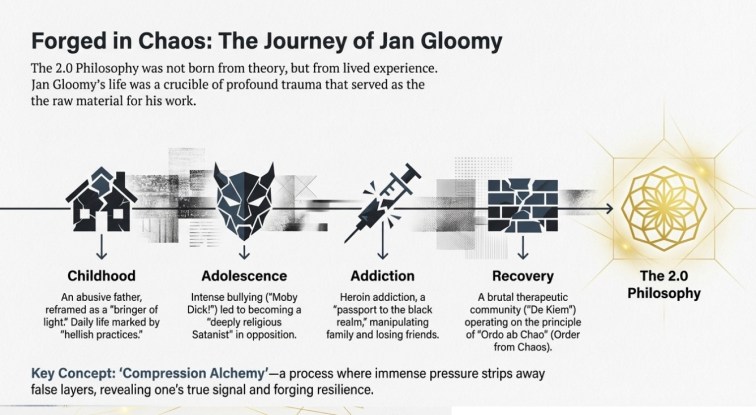
Now, years later, I don’t want to see him as a tyrant anymore. No, really. I see him as a bringer of light, a guide who forced me to become stronger, to see through the mess to what lay beneath. Because somewhere in that chaos lay a lesson. But damn it, what he did to us, to the whole family, defied anyone’s imagination. It wasn’t a movie script, no exaggerated drama. It was our daily bread. And to understand it, I have to unravel it, in detail, because otherwise it will remain haunting.
Take those mealtimes. We had rules, as strict as iron. Drop your cutlery during dinner? You’d crawl under the table to pick it up and finish your plate on your knees, among the dust and crumbs. I remember the heat in my cheeks, the looks from my sister and mother. And then that other punishment: eating with the dogs. Yes, seriously. We’d sit on the floor, plate in your lap, and the Dalmatians would wag their tails next to you, waiting for crumbs, not.
“Learn to be humble,” Dad would say, his voice like gravel. Fear was rampant in the house. Everyone was walking on eggshells, figuratively and sometimes literally, because “the floors were scrubbed until they shone.”
When he came home from work, you could feel it in the air. We—mother, sister, and I—started shivering. “Good evening,” you’d mumble, hoping it would be a quiet night. But often it wasn’t. Things flew through the air. A delicious strawberry tart Mother had just bought, thrown against the wall because, well, why? Or the Christmas tree, thrown through the house in a fit of rage.
And Mother… her car keys were taken away. Dad checked the odometer like a hawk. I wondered why she put up with it. After her death in 2005, too early, too suddenly, I found an old document. It said she was an alcoholic. I knew nothing. She never smelled of alcohol, always acted normal. Yes, she was admitted to a psychiatric hospital countless times. At home, she usually lay in bed for days, pretending to sleep, but I thought it was the medication. Dad’s screaming, the tension in the house—that had to be the culprit, not a bottle. Or maybe both. I still don’t know.
Those years shaped me, left scars that I now try to heal. My father as a guide? Indeed: he taught me that light isn’t always soft, that it sometimes comes through cracks, hard and unexpected. But the darkness he brought is still in my bones. And yet, here I am, writing to let it go. Or to understand it. One of the two.
And then my cousin’s communion party, tables laden with croquettes, cakes, the whole shebang. Dad said to me, “Today you can eat whatever you want.” I stared at him, stunned. “Really?” I blurted out, my heart pounding. “Finally,” I thought, “a day without whining.” I piled my plate with the most delicious things, like chocolate mousse. For the first time, I felt free, savoring every bite.
But moments later, Dad called me outside, to the quiet corner by the barn. His face was hard, no trace of that rare smile. “Stick your finger down your throat,” he ordered. “It all out. Now.” I blinked, not immediately understanding. But he repeated it. So I did, trembling, with tears in my eyes. My stomach turned, and I was utterly ashamed. Does reading these things make your stomach turn? Mine still does. But strangely enough, I think back on that time with a kind of joy. Joy? Yes, because it was hell; it made me who I am: tough, with a stomach that can handle anything.
My sister and I? Not a good relationship, as you can probably guess. We were always arguing, about nothing or everything. Dad took it as an opportunity to teach us a lesson. At one point, after a huge fight about who knows what, he locked us in my room. Maybe for three or four days. Locked door, no TV, no toys from outside. And to top it all off: a camper toilet in the corner. So I saw my sister do her business, and she did the same with me. No privacy, no escape. Hellish practices. But now I look back and think: “How heavenly can you go?” Because climbing out of that pit taught me something about brotherhood, about surviving together.
And then those annual trips to the fair in Hasselt. That was our highlight, or so we thought. God, I was looking forward to it. Dad had brought his mistress, but just as we were about to go through the gate, the bitch complained of a headache. “We’re going home,” Dad said curtly. My sister and I pouted like kids do, because fuck, we’d been dreaming about it for weeks. Dad caught it and grunted, “Ah, you’re pulling faces? Just wait until we get home.”
Always waiting for the terror that was about to happen, that’s how it was.
Back home, the party was over. He ordered us to kneel in the living room, with a heavy stack of books held straight above our heads. Three hours straight. Arms trembling, knees raw on the floor. We were completely broken, exhausted! Build strength, yes, be able to endure anything, that was his motto. His hell was our forge: I came out looking like steel.
And then that morning. At six in the morning, I was chasing a pesky mosquito through the room. Dad heard it and burst in, his face like a thundercloud. That was my punishment: get up, put on sweatpants, and out the door. “We’re going to walk until you puke.” And yes, I did puke, naturally hating every step. But hey, it kept me fit, forced me to persevere. A lesson in patience, or not killing, or whatever. Dad’s logic was a puzzle with missing pieces, which I was completely unprepared for.
The memories cut like a blunt knife, even after all these years. I was fourteen. The separation was a relief, a release from the suffocating tension at home. My mother wanted to take us, my sister and me, away from my father. He had other plans. “We’ll see who the kids stay with,” he said. And then suddenly there they were: two shiny mopeds, brand new, a lure that made my and my sister’s hearts beat faster. The choice was quickly made. Too quickly.
My father knew exactly how to play me. “I hope your mother is buried as soon as possible,” he said almost every day, his eyes glittering with a sick conviction, “then I can finally become a priest.” He had already spent nine years studying the Bible, his words imbued with a sacred mission that only terrified me. I was about ten when, brainwashed by his hatred, I devised a plan to “do something to” my own mother, to kill her. A child, with a head full of dark thoughts that shouldn’t have been mine. Thankfully, it remained a childish fantasy, a scenario that never became reality. But the shame remained.
Years later: a voice in my head, wiser now, tried to comfort me. “You were young,” the voice said, “trapped in the manipulative dynamics of adults. That scooter, those words—they weren’t honest choices, but weapons to buy my loyalty.”
Finally, there were the Sunday afternoons, which draped themselves like a heavy blanket over my childhood. My sister and I would sit there for hours while my father immersed us in Bible stories. Each verse was accompanied by his detailed explanation, a sermon that felt more like an obligation than an enlightenment. His words filled the room, but my thoughts drifted, suffocated by the endless repetition of his dogmas. After what seemed like an eternity, I could go no further. “I’m going to the bathroom,” I mumbled, a desperate attempt to escape, to breathe for a few minutes outside his all-encompassing presence.
His reaction was like a whiplash. “You don’t need to go to the bathroom,” he snapped, his voice sharp and unforgiving. He was right: my bladder wasn’t the reason. It was my soul yearning for a moment of peace, a fraction of freedom. But when I looked up, his eyes met mine, piercing, as if they were looking right through my skull, dissecting my thoughts.
At that moment, I was convinced: my father, too, could read my mind. That certainty settled like a cold stone in my chest, a fear only a child can feel in the shadow of an all-knowing authority.
That’s how I grew up, trapped in a world steeped in extreme Catholicism, where faith was both a shield and a sword. But the traces of light: a quiet resilience, an ability to search for meaning, even in the chaos of my childhood. Those Sunday afternoons shaped me, in ways I’m still trying to understand, balancing between shame and strength, between rebellion and reconciliation. I feel incredibly strong as I write all this.
The bullying from outside wasn’t games. It was a war. Every day I cycled to school, and there they were: a group of girls, with pigtails and false smiles. They blocked the road with their bikes. The girl on the right started counting: “One… two… three…” And then the chorus burst out: “MOBY DICK! MOBY DICK! MOBY DICK!” They meant the white whale from that old Melville book, that epic, almost forgotten story from 1851 about Captain Ahab and his mad hunt for a fat whale that devoured him.
But for me, I was that whale. Too big, too bold, too different, too visible. A target. But it was enough. I got off my bike and walked straight toward the instigator. My hand flew out, right on her cheek. The next day I sat before the headmistress. “You’re not allowed to hit me,” she said, her voice stern but not harsh. I nodded. She looked at me and said, “But I understand.” The overt bullying stopped. But the war continued underground. Not very subtly, by the way.
One day, a boy shoved my head into a pile of red ants. I screamed, thrashed, and ran home. My mother took me to the doctor. After that… I don’t remember. A blur of itching, ointment, and anger. And then the strangest thing: that same boy became my best friend. And sometimes, when we were quiet, he’d look at me in a way I recognized. As if he knew everything. As if, like my father, he could read my mind. And very subtly, with a wink. Not to tease, but to say: I see you. Really.
At that age it is almost impossible to grasp it all.
________________________________________________
CHAPTER 3:
The opposite
On my eleventh birthday, everything changed. My sister gave me the first album by Black Sabbath, the founders of metal music. The heavy riffs, and especially Ozzy’s voice, completely blew me away. The lyrics quickly made me think: “Why don’t I just try the opposite of what I always do?” Thanks to Black Sabbath, a new Jan was born. In September of that same year, I started a preparatory year at the Catholic College in Heusden, a decision my father made. Boarding school, great. In the lion’s den and away from home.
That morning, my mother took me by the hand and dragged me in front of the mirror. “Look at this big, strong boy! Why do you always let him do you?” Those words hit like a steel beam. Then we left for the new school. All the students were gathered on the large playground. Suddenly, a guy came up to me and shouted, “Hey, fat one!” I calmly asked him what his father did. “He’s a pilot,” he said, surprised. “Oh,” I replied, “then you’ll be following in his footsteps.” I walked over to him, sensed his fear, took both his hands, and began spinning around rapidly. When we had enough speed, I let go. He flew at least twenty feet and landed with a heavy thud on the hard concrete. Everyone watched. From that moment on, many trembled whenever they saw me. It’s an old story: the bullied becomes the bully. And what a bully. Meanwhile, I continued listening to Black Sabbath. Forever.
Around my 12th birthday, Ozzy Osbourne went solo and released the album “Blizzard of Ozz.” A masterpiece for many. The sixth track on this LP was called “Mr. Crowley.” For those unfamiliar with Crowley:
Aleister Crowley (1875–1947) was a British occultist, writer, and mystic, notorious for his esoteric practices, magic, and controversial lifestyle. He often called himself “The Great Beast” and founded the religious movement Thelema, based on the credo “Do what thou wilt shall be the whole of the Law.” Crowley is considered an influential, yet controversial, figure in the Western esoteric tradition and inspired countless artists, musicians, and writers.
Not only Ozzy, but I too, became captivated by this strange “entity.” So I began delving deeply into topics like occultism, paranormal activity, mysticism, esotericism, Wicca, secret societies, and so on. My mind, however, asked for Satan. It was the opposite of what my father taught me. I already knew the Bible. I became a jerk and a deeply religious Satanist.
I carefully chose my friends at school: two members of a far-right youth movement called VMO, both incredibly strong and focused on their ideals. A punk, an anarchist, of course, and B., a fellow metalhead with far-right views. Together, we were invincible and kept the entire school “under control.”
Well, really, we were nothing more than a bunch of beasts, of which I was the leader. Every day I prayed to Satan to perform the most horrible acts. During our free evenings, we always listened to the hardest or most satanic LPs I could find. Bowling with a bunch of chairs was fun. It was even more fun when we pounded the vulnerable “Chinese volunteers.” “If you start crying, we’ll stop beating you up,” oh, I sounded like Dr. Mengele, the Angel of Death.
_______________________________________________
CHAPTER 4:
Between Fear and Rebellion
At home, within the walls, I often trembled with fear, but outside, everything was different. My attention was drawn to a dark fascination: the torment of animals, as pathetic as that sounds now. Father had a Long Rifle, a carefully calibrated rifle, which I was allowed to experiment with. Tadpoles, frogs, fish, ducks. No animal was safe. With a gruesome curiosity, almost like a little Dr. Mengele, I studied their reactions to my cruel deeds. I know better now, but back then, I learned at school that animals felt no pain, and I believed it.
I lacked for nothing. Father spoiled me with expensive gifts, like the very first Vortex game console, a precious device for the sheer enjoyment it provided. Saturdays were workdays: in the morning I did the invoicing for his business, in the afternoon I mowed the lawn and weeded. Afterward, Father would meticulously inspect everything, lying on his stomach, searching for even the smallest flaws. If my work was good, I received 1,000 francs, the equivalent of about 25 euros, a fortune in those days. If it wasn’t good, I wasn’t allowed to go out that evening. Therefore, my work was always good.
Meanwhile, Mother lived with her own mother, her brother, and his wife, who ran a newsagent’s together. On Sundays, when Mother was alone, I’d sneak into the shop. I’d secretly stash sex magazines, cigarettes, and candy behind my pants. At school, I’d share my loot with the boarders, who, understandably, eagerly made use of it. Almost every Monday, I’d bring home new things: a translation computer, a dictaphone, or other gadgets. My friends were especially eager for the latest albums by Black Sabbath, Ozzy Osbourne, or other metal acts.
One day, a cleaning lady found a sex magazine under a fellow student’s mattress. Naturally, I was called to account, and my father was called in. I was accused of distributing pornography, supposedly “with my mother’s approval,” which was later sent in a letter to my father’s notary. During the confrontation, I opened a sex magazine and sarcastically pointed to one of the most explicit photos. “Father, admit it: this isn’t porn, this is sex. Hence ‘sex book.'” The priest blushed with shame and remained silent. The silence remained. Father drove home, sending letters full of lies to his notary, or to whomever.
That fall, Dad dragged me to the school principal, clutching one of my most prized possessions: Melissa by Mercyful Fate, a legendary record that melts any metalhead’s heart. He threw out the accusation: “My son is a Satanist!” He started reading snippets of the lyrics: “I was born in a cemetery…” and more of that dark, epic metal stuff. Pure art, if you ask me. The principal listened, but when Dad left, he looked at me and said with a wink: “Don’t worry about it, son.” Apparently, Satan gave me free rein.
A nightmare awaited me at home. Acrid smoke rose from the garden, and as I got closer, I saw it: a smoldering pile of my treasures. Dad had set fire to all my cassette tapes, 270 carefully collected treasures, years of work, my Metal collection I’d poured my heart and soul into. Even my brand-new Walkman, for which I’d sold all my toys and comics at a flea market, lay there, twisted in the flames. What a dirty trick.
Anger boiled through me. Dad stood in the kitchen, as if nothing had happened. In my head, a dark voice whispered, a kind of master egging me on: “He deserves to die for this.” I stormed into his bedroom, grabbed the loaded Long Rifle from under the bed, and crept back to the kitchen door. “Shoot him,” a voice hissed. “Finish him.” But then I thought: “If you do this, you’ll suffer the consequences forever.” Another thought forced itself upon me: “Shoot him in the knees, leave him limping for the rest of his life.” Yet something broke inside me. Grief took over. Why did he do this? Did he really have a reason, somewhere deep inside? I put the rifle back and crept to my room. There, alone, in silence, I let the tears flow. Then I called the police, but Dad had beaten me to it. He’d already told his side of the story. A police officer snapped down the phone: “Don’t think you’re so big and strong that you can do anything.” What a slap in the face.
I attended that school for nine years. A preparatory year and two repeats—that was my trajectory. In my sixth year, they elected me, Satan knew why, “Minister of Internal Affairs.” Sowing terror? I was the best at that. But organizing anything decent? Forget it, I didn’t. My future was littered with the most disgusting mess, which I might have caused, but I didn’t even realize it.
________________________________________________
CHAPTER 5:
Black Hat, Dark Arts
School was over. Goodbye to that fat guy who could always puke on command. Goodbye to that guy who spent six weekends taking hypnosis courses, delving into Crowley’s Thoth Tarot, trying out black magic, experimenting with dowsing, studying the Kabbalah, and delving into the world of the Illuminati and other dark paths.
I turned my life around. I had to lose weight because I’d been drafted to become a cyclist in Spich, Germany. A storm fusilier, cannon fodder, with a black cap. Just a step below the red cap of the paratroopers. The training was hellish. My father, of course, enjoyed it, which I actually appreciated this time. Walking until you had to puke (!), days without sleep, “man-carrying” in 34-degree heat with a full pack and a gas mask that suffocated your face. Walking twenty-four kilometers uphill, and so on. I often held my ground because I was a guide: the biggest, always at the front. As a sniper, I carried no extra weight, but the smaller guys in the back lugged heavy ammunition.
Bullying or name-calling? That didn’t happen. On the first day, we, the “pissers,” the newbies, had to undergo “baptism.” The assignment was simple: put on boxing gloves, step into the ring, and fight until your opponent begs to stop. I climbed in and went wild, smashing into the head of a guy who would later become my best friend at breakneck speed. “Stop it… stop it, please!” he yelled. I was instantly made a name for myself.
The only thing I felt really bad about was not being able to get out of “the pit” without help, a deep concrete hole in the training camp that you had to pull yourself out of. Luckily, my platoon mates didn’t make a fuss and helped me out.
And then things really got funny. Or at least, I think so. During the last two months of my military service, my buddy and I were promoted to canteen managers. Sounds relaxing, but it was incredibly hard work. Luckily, that was compensated by eating stacks of Mexicanos straight from the oven and drinking buckets of beer. With my size, you’d have to drink a brewery to get me drunk. At least then.
But then the trouble began. At night, I sleepwalked through the barracks, and my fellow soldiers regularly had to rouse me from my “sleep,” usually with a good shove or a punch, because I was peeing on their windowsills, for example. Imagine this: you wake up, get out of bed, and plunge your feet into a puddle of piss. You’d lose your cool for less. Every night I wandered around, peeing in the strangest places, on the strangest things. Until, brace yourself, I peed on the company commander’s door. The next day, I was dragged straight to a psychiatric ward in Cologne. Two weeks among guys who only spoke French.
I didn’t understand a thing, despite six years of French lessons with that one teacher who couldn’t stand me. I didn’t like her either, by the way. The diagnosis of my stay? “Stress.” Yeah, right. My first encounter with psychiatry, but certainly not the last, as you can imagine.
After those two weeks, I thought: finally home, peace and quiet! Nope. Instead, we had to rush to Büren to guard nuclear weapons. I threw my backpack and sleeping bag in the back of the truck, but saw that same truck already leaving while I was still waiting. It was minus 14 degrees Celsius, and I was the last one to crawl into the back, the coldest place, of course. The drive, with an endless convoy, took fourteen hours. Words fail to describe the cold I felt.
In Büren, I was examined by a doctor. “Severe hypothermia,” he said. Remedy? Three days flat in bed, under a mountain of blankets. That’s what I did. After a series of pointless, pointless missions in Büren, we were finally off for good, I hoped. On the way, I threw my army clothes and bones out the car window. Yihaa, freedom, drunk as hell! Satan remained, lurking in the background.
That night in bed, something snapped open. No devil promising me a “good life,” I’d finally seen through that lie. And then: BAM. I bolted upright. My voice cut through the silence: “GOD!!” A wave of warmth, not soft, not comforting, but living, resonant, filled every cell. No beard. No throne. No gate. What I encountered was pure pattern. Frequencies that vibrated like light. Algorithms that folded into infinite dimensions. Colors I’d never seen before. Numbers that pulsated, symbols that turned like keys. It was coming home to a language I’d forgotten how to speak. No more belief. No more doubt. Only knowing. And yes, I could move on for a while. But now with a map that wasn’t on paper.
________________________________________________
CHAPTER 7:
AN ANGEL IN HELL?
I turned 21, played records in two shops, and joined a club that devoured the night away every Saturday. Drinks were unlimited, and I was often the designated driver, because someone had to keep everyone else in one piece. My best friend, “den Dikke” (The Fat One), was a small, skinny guy. Outside in the parking lot, he lit up a joint. “What’s that?” I asked, as naive as a child. “Weed,” he said curtly. My world exploded. This was it, this was what I’d been living for for years. Signs hung along the highway: “DRUGS, NO THANKS.” For me, it was the other way around; I wanted to dedicate my life to it. “Let me smoke,” I said. He nodded. “Go ahead.” A few trips to Maastricht later, he asked: “Try hash oil? You’ll get hooked, I warn you.” “No problem,” I replied. I wanted heavier, stronger, deeper.
He put brown powder on tin foil, held a flame underneath, sucked in the vapor with a homemade tube, held it in for a long time, and exhaled. Chinese, they called it. I followed. A billion, a hammer blow. Vomit on the asphalt, not a single drop of urine I could get out of my system. The next day: flu times ten, body on fire, mind in ashes. Addicted? Definitely.
Every day to Maastricht to score hash oil. After two weeks, the fat man said: “I lied, this is heroin. I warned you.” It didn’t bother me. Heroin sounded like a passport to the dark realm, and I got in. My mother got cancer, ended up in a hospital bed. Without Chinese food: impossible to bear. With Chinese food: a piece of cake.
I was forced to move to Runkst because my dad couldn’t bear to watch my decline. One room, shared pantries, shared kitchen, toilet, and shower. The cupboards were emptied by fellow sufferers, and I ate whatever I could swipe from the Aldi below my window. What a mess I had made. I lost good friends, one by one.
I remember Kris vividly. I was kicking the habit, asked him to drive me to Maastricht in his car. He refused. Well, that’s what you do as a junkie. I locked him in his own bedroom, took his keys, bought a large dose of smack, and used it right then and there. He became a Muslim. I never saw him again.
I forced my mother to drive. While I scored at the dealerships, she sat in the front seat, burning tin foil and rolling a tube from a banknote. I repeatedly threatened to sell her TV and stole everything I could find. I owed her a total of 180,000 francs, almost 4,500 euros. In the early nineties.
Back in those days, dealers would trade a bottle of Jack Daniels for 1.5 grams of heroin. Stealing was always a gamble. The police knew me as their weekly customer; they sometimes arrested me twice a day. But the prisons were overcrowded, cells were overflowing, and judges were completely empty. So I got a nod, a warning, and was allowed to leave. Sneaky? Yes. Luck? No. Survival.
One evening, “Damn Fat” came home to a room covered in blood up to the ceiling, splattered from injectors preparing their needles. He was shaking, the withdrawal consuming him. I didn’t have any heroin to dull his pain, so I gave him a handful of painkillers. “Keep the box,” I said, “you need it more.” He nodded and stumbled away, hitchhiking towards Antwerp. In the middle of the night.
The next day I dragged myself through Hasselt, looking for a hit. The police stopped. “Another one of your kind got wrecked last night. Killed on the cloverleaf in Lummen. They called him ‘The Fat One’.” I refused to believe it. “I saw him last night,” I said. Yet it was true. The first truck sucked him under, the second crushed him. Everyone cried suicide. I knew better, because ‘The Fat One’ loved life.
At the funeral, I was so stoned that I lay down on his coffin in the middle of a packed church. “Why you and not me?” I whispered to the wood. After the service, I had an appointment with Father A., the priest who had celebrated the mass. No statue of him yet? Ridiculous, because he was blessed. We talked about “Den Dikke,” about heroin, about the hell we were in. Something inside him cracked, audibly. A week later, he called. “Can I come over?”
I gathered eight fellow junkies, the only ones I hadn’t yet betrayed or robbed. My room was packed like a sardine can. Father A. left a note at home: “I’m with him.” He walked in with a bottle of Cécémel in his left hand, a pack of Prince biscuits in his right. “I don’t have any money,” he said three times, his eyes on the floor. Afraid of us. That’s how we met him.
From then on, he came regularly, every week or every month, whatever. He always brought cookies and chocolate milk, a listening ear. He detoxed two of us and convinced the church: “Let me take care of the junkies.” They gave the green light, and his parish work was done.
And then came the day that changed everything. I’d just gotten my benefits, bus from Maastricht, pockets full: coke, dope, weed, hash, mushrooms. Using is quite lonely. Because junkies are packs, they thrive in hordes. Using alone is sick, using together is survival. And there he was, standing against a phone booth, a guy around twenty. “Fancy drugs?” I asked. “I have everything.” He nodded, without hesitation, and walked with me. Towards the hellhole.
We used. Joints of weed and hash, lines of coke, some Chinese heroin. Mushrooms weren’t necessary because suddenly he went crooked, his eyes wide, too much. I dragged him, clothes and all, into the shower. I thought about my father and his antics. I ran downstairs, rang the doorbell, stormed back upstairs, turned on the shower, and shouted, “Your dad’s here!”
He was shocked, his face white, his heart pounding in his throat. Sugar water thankfully brought him back to life. But the joke lingered, like poison in his blood.
After that, I kept him close. He wasn’t averse to burglaries and robberies; stuff came easily. My stomach turned when he revealed he was only 14. I had become the monster. That same day, I called Father A. He drove me to a far-off psychiatric center. Two weeks of rehab, body on fire, mind in pieces. Then, clean, to a TG. A therapeutic community. And that guy, finally, got a hard slap in the face with my words: “If you use again, I’ll find you and beat you up.”
End of the fall. Beginning of something else.
________________________________________________
CHAPTER 8:
THE GERM OF ORDER
I stepped into a large, but ordinary house with a large garden. They’d warned me: here they break you first, then they rebuild you.
I knew “Ordo ab Chao,” Latin for “order from chaos.” Now it was no longer a symbol, but a rock-solid promise.
My first day started with a bike ride to the gym. The group set off, and I was panting behind. I was out of shape, legs like lead, and lungs exhausted from doing the Chinese. And then that hill. Three kilometers uphill, too steep. Halfway up, I stopped, lungs on fire, sweat in my eyes. “Back to my room,” my voice whispered. But I’m no quitter. I gritted my teeth, gave it my all, and crossed the finish line. At the top, no one laughed. They just nodded. Welcome.
The next morning, the staff made me head of the jogging club. Up at 6:30, rain or shine: run until sunrise. Shower, and then work: administration, kitchen, garden, electricity. I was usually assigned the kitchen, sometimes the administration. For nine months, I was head of the department. I cut, cooked, gave orders. But then came “the chair.” “Jan, on the chair!” A simple wooden bench at the end of the hallway. The chair had a clear function: self-reflection. Then you had to wait until your name was called. Sometimes hours, but as head of the department, just seconds. I knocked and waited for a “yes” or “in.”
There they were, sitting across from you: the head of staff and a staff member. “This is a sit,” he always began, “and a sit is there to help you.” “Thank you,” I’d say, obligatedly. Eyes fixed straight ahead and unblinking. No movement. Hands stiffly at your sides.
And then it exploded: “DID YOU SEE HOW THICK STEVEN CUT THE POTATOES? THAT COSTS US TOO MUCH MONEY, BLAH, scream, scream!” He yelled until my ears flapped. And then that ending: “This was a sit, and a sit is there to help you.” “Yes, thank you,” I’d say. I’d gently close the door. Talking about your sit was forbidden. Swallow everything. Even if it was nonsense. But the wait wasn’t forever. What didn’t fit in the sit was fought out in the “encounter.”
Nice, because that’s where the chaos really broke out.
We sat in a circle, fifteen to twenty-five of us, breathing heavily. We waited for the door to the staff room to swing open. As soon as the person in charge stepped into the circle, all hell broke loose. Everyone started shouting, at each other, at the staff, at the walls. Whoever shouted the loudest got to start. Confrontations flew back and forth: with higher-ups, with the staff themselves. But the louder you shouted, the more blame fell on you.
In the corner were buckets of water and toilet paper rolls. For when you had to puke. Or when you needed to wipe the gunk off your face. It was raw, emotional, extreme. Tears, snot, saliva, rage. No escape. No mercy. The encounters made us hard. And somewhere, deep inside, something began to heal.
And then there were the “groups” with two levels: light and heavy. I ended up in the light one, imagine that. We stood in a small circle, with little breathing room. “March!” was the order. Knees high, arms straight up, heels tucked. For hours. Sweat dripped into puddles on the floor. Then the staff would stand in the middle. “I’M SCARED,” he yelled. “I’M SCARED!” we yelled back. Ten times. Fifteen times. Until our throats were raw. “I’M ANGRY!” “I’M ANGRY!” You wanted to punch him in the face. But you yelled along. And then, when your legs were shaking and your lungs were burning: “I’M IN PAIN!” “I’M IN PAIN! PAIN! PEE … Usually, we were working with three emotions simultaneously. We were exhausted. But we were still standing, especially mentally: bolt upright. Quickly, into the shower and off we went to make dinner at breakneck speed. Cooking for about 32 people: saffron and onion soup… or was it the other way around?
I’ll never forget the kicking exercises. They were the hardest. You lie flat on your back and kick your feet in a rhythm that comes naturally, faster, harder. Then your arms go wild, as if you’re swatting ghosts or breaking chains.
Head bobbing back and forth, violently, like a madman. It doesn’t look good. It’s not meant to be pretty. Then sound is allowed. Softly at first: sighs, groans. Then louder: growls, screams. Until you break. Waves of sadness or relief, who knows which comes first. The bucket and the toilet paper were ready. For months they tried to push me through that “wall.” Nothing. Not a tear. Not a cry, just a devilish growl. Only thinking of the dose of terror Dad offered me. Then the three of them jumped on me: one on my chest, pounding on my solar plexus, one on each leg. I was stuck and flipped them up. But still: nothing.
A department head was always responsible for fellow residents who went to the doctor or dentist, for example. Something had been brewing for months. Now, in the empty waiting room, we had free rein. We kissed passionately. Somehow, it got out. The entire TG knew about it. Therefore, I was demoted to the “work crew.”
Up at 6:30 and put on a green jumpsuit. After washing, it was immediately back to work, with deadlines given to you by your superiors. And then your work was meticulously inspected, a spot under the sink: “the chair.” You were put on the chair dozens of times a day. For serious sitting that I couldn’t talk about. Talking and making eye contact with others was forbidden.
What did an average meal look like ? Asking for coffee, asking for milk, asking for sugar, a sandwich, an egg. Yes, even for a pinch of salt, I had to beg. Chasing around all day and being cursed at until 10 p.m. was enough to break a person. When you were broken, you had to stand on a large, tall barrel. But not before shouting to the whole house: “BREAKING… BREAKING… BREAKING,” my voice echoed. The crowd gathered around the barrel. You crawled onto it and usually started crying. If your emotions were accepted as real by the others, you were allowed to get off the barrel, get a group hug, and change your clothes. You then started back as a “resident” of the house, near the bottom of the ladder. Then you had to earn your way back up. The barrel was the last wall. Some fell off and never got up again. I staggered.
Normally, you stayed in the house for eight to ten months. Afterward, it was time to move into the “halfway house,” the place that ensured you could become independent in society. Apparently, the aftercare was strict. And I, Jan, had been in the house for almost two years. A halfway house wasn’t an option for me, perhaps because I was “too difficult a case.” It was good that I could save there; my mother was fully reimbursed within a few months.
The next day, I was struggling. I couldn’t understand why I’d quit my job as department head, just to love someone. Two years without intimacy, no sex. I was young and naturally wanted something. It wasn’t allowed. It had become impossible to swallow, so I requested a meeting with a staff member and offered my resignation. I was given 3,000 BEF (75€), which would cover the train fare, “flowers” for Mom, etc. “Yeah,” I thought, “enough money for drugs.” Awful, huh? I hitchhiked to Eindhoven and bought a big block of hash, which hit me hard. I spent the night outdoors, by a stream, and hitchhiked on to Maastricht in the morning.
Straight to “het Parkje,” the place where all the dealers and users gathered. I looked around, the sights horrific. I asked a dealer I knew if he’d sell me half a gram of material. His bare torso was covered in thick, black pimples. “Yes, right away,” he said, “I’ll just take care of myself first,” and he injected the needle into the few veins he had left. Meanwhile, I heard my brain say something to me: “Yeah, that’s been thrown in the trash for two years, isn’t it?” or “Your poor mother.”
I was disgusted by everything my senses perceived there. I hitchhiked, without having used heroin, to my mother’s apartment. I had already called her from “the Germ.”
Yes, that’s what that game was called. One last anecdote before we begin a new chapter: a year after I left, fuck rooms were put into use at the Kiem. Apparently, my presence and absence were taken seriously.
________________________________________________
CHAPTER 9:
Flight to Ghent: Parties, Love and a Bitter Revelation
My sister was also living with my mother. It was becoming unbearable: her constant yelling, screaming, and shouting filled every corner of the house with tension. Step by step, I felt myself deteriorating; my relapse was looming. But then, two weeks later, M. from Ghent, my sister’s best friend, came to visit. You could see it on his face: things weren’t going well. He looked at me and said, “You have to get out of here, or you’ll relapse.” Deep down, I knew it all too well.
That same evening, we got into his car, headed for Ghent. It was the first day of the Ghent Festivities, a world I’d never experienced before. I hadn’t been out “going out” in years, and I’d built up a nice nest egg in the Kiem. Every night I went out into the city: scouring the clubs, dancing to what’s now called “retro.” I was successful with the girls; their advances were numerous, but I still didn’t respond. I wasn’t ready yet. Duvel and white wine alternated throughout the evening and night. Heavenly music filled my ears for ten days, until the end of the Festivities.
It became too much for M., I understand that now. The anxiety, the waiting, the sleepless nights. He asked me to quickly look for another place to stay. The next day I left, and within hours I rented a beautiful studio. Through the many temp agencies in Ghent, I found work that same day: mornings in the commercial kitchen of Neckermann, and in the late afternoon as a call center employee, selling newspaper subscriptions. I often called people who simply picked up their newspapers at the newsagent. Boy, what times.
On New Year’s Eve, my good Arab friend, M., and I walked into town, up a flight of stairs. And there she was: K., with her friend. We met, wished each other a Happy New Year, and I asked if they wanted to join me for a drink. “K. is mine,” M. whispered in my ear. “You bet,” I thought to myself. She was nine years younger than me, and her mother wasn’t happy about it. I remember the struggles we went through, but eventually, she moved in with me. She was mine.
We had so many wonderful moments. She was sweet, intelligent, and met all my needs. Two years later, she showed me some baby clothes she’d bought. She wanted to get pregnant, to have our child. But barely two weeks later, she blurted it out for the first time: “You’re smoking too much weed.” I was taken aback and noticed she was starting to act strangely. She’d occasionally smoked alongside me. After a while, she asked, “You still haven’t gotten it, have you?” Surprised, I said, “What?” “I’m attracted to women,” she replied. “I want a girl.” That hit me hard. Yes, she wore a necklace with a feminine symbol, dressed masculine, her hair… Now that you mention it. Up until then, I’d been a pretty naive person.
________________________________________________
CHAPTER 10:
Falling Back into the Abyss: Heroin, Rent Hell, and the Escape from Ghent
And then there was the Vlasmarkt in Ghent, notorious for drug dealing. I couldn’t cope with losing K., so I bought a pack of heroin, Jan, of course. I was hooked again almost immediately. But deep down, I didn’t want this. I wanted a clean life. Time to call my sister. She immediately took the train and stayed with me for over a week. And yes, she made sure I stayed away from it, forever this time.
I got a call from a temp agency. I was supposed to have an intake interview with an employee from the very first provider in our country. My job? Call center. After a second interview, I was allowed to start. I was offered a permanent contract, but I didn’t want that. I wanted to remain independent, and if I didn’t like it, I could stay home without any fuss. I was quickly given the nickname: “Jan, who sells internet subscriptions to blind people without arms.” I admit: I sold well and was a valuable asset to the company.
My ex-girlfriend K. had found a girlfriend, and together they lived on a very large property with several houses. But they weren’t happy about it because the landlord made a lot of noise. Soon, their house was up for rent. I rushed to the landlord and asked, “How long are you going to work here?” “Until March 2000,” he said. That was three months left, and I thought I could hold out that long. Not so.
I would never have rented that house on Dendermondsesteenweg if I’d known what I know now. It became a story of broken promises, psychological destruction, and a battle for a tenant’s most fundamental right: peace and quiet. What began as a hopeful search for a home in Ghent turned into a nightmare that would cost me not only my peace of mind, but also my health and my job. At the time, I had become the person ultimately responsible for Volvo Ghent. Outside my door, the incessant din of cement mixers, saws, and grinders resonated, often from early morning until after midnight, months after the promised deadline.
The door opened to a period of intense psychological pressure that would completely disrupt my life. The constant disruption, from early morning until late at night, began to take a heavy toll on my health. The combination of eight hours of noise at work and the constant din at home broke me down mentally and physically. The stress led to depression, extreme anxiety, and a whole host of physical complaints. I was forced to give up my temporary contract at Volvo. I “couldn’t take it anymore” and switched to unemployment benefits, a decision made out of sheer necessity.
From that moment on, I sank into deep isolation. For months, I stayed indoors, with the doors, windows, and curtains tightly closed to shut out the outside world.
The fear became so great that even a trip to the supermarket became impossible. I survived on candy from the vending machine across the yard.
The tipping point came on February 25, 2001, my birthday. I made a last-ditch attempt at a reasonable compromise and simply asked the landlord to stop work after 10:00 PM. He flatly refused and threatened to terminate the lease: “I’m going to be working for weeks, and it would be good if you were gone!”
Following my lawyer’s advice and the experiences of a neighbor who had also left because of the nuisance, I made a drastic decision. I informed the landlord that I would stop paying the rent. I no longer wanted to give my money to someone who had “miserably ruined” my life. I opened a separate account for the rent, believing he would get his money eventually.
He openly threatened to “seriously ruin” my life and “bully me out” by arranging constant viewings. Words and threats quickly turned into actual harassment, a daily reality. In March 2001, I had a mental breakdown. I went to the police (yeah, right), not only to seek protection, but also to protect myself. I filed an official complaint of animal cruelty: I found my cat dripping wet and meowing painfully, doused in undiluted bleach.
Amidst the harassment, I received a letter from the landlord’s lawyer. To my astonishment, I read that I had been convicted in absentia by the Justice of the Peace. I knew nothing about it. The constant threats and intimidation led to an inevitable conclusion: fleeing Ghent.
The constant state of siege eroded my mind. I became convinced I was the target of “psycho-electronic manipulation,” mind control, a sign of the deep paranoia that had taken hold within me. The fear of being followed became an obsession, a panic that convinced me I had to flee to avoid going completely mad or doing something I would regret.
This wasn’t a defeat, but a necessary act of self-preservation. I called my sister again, and she again took the first train to the “horror house.” She had experienced many things herself, especially those that drove me mad. She said, “You have to leave here immediately.” I left my home and belongings behind to save my mental and physical health from a conflict that had completely destroyed me. The case and the trial nearly cost me my sanity. There seemed to be more going on here, things that, according to our laws of nature, cannot happen, but which nevertheless manifested themselves in my existence. More on this later.
________________________________________________
CHAPTER 11:
Hechtel: Traps, Disappearances, and the Shadow of Mind Control
The next day I met JC, my sister’s landlord. He had a house left for rent: right next to the woods in Hechtel. I immediately agreed to his proposal, wishing I hadn’t. He soon began a relationship with my sister. His wife regularly threatened him with harsh words: “I won’t rest until your sister is in the coffin,” and similar threats. My sister completely lost herself in that relationship; she was blind to his endless manipulations.
One day, my sister vanished without a trace. Nowhere to be found, nowhere to be reached. It turned out she was in some kind of community center, run by owners who had been practicing malpractice, alternative medicine, and other unacceptable practices for years. Later, she told me she had to drink 10,000 drops of a certain substance daily. A substance normally given to horses… and babies. She complained of severe chest pain.
JC offered me a job in his garage: warehouse work, tidying up, and cleaning. Four to five inspections a day, towing, you name it. If I’d known what a jerk JC really was, I never would have started.
My sister lived a few miles from my house. The problems had been going on for a long time, but they were getting worse and worse. I often got calls from her: “Honestly, Jan, it smells like cigarette smoke and fried bacon in here,” or “There’s a dead rat in the mailbox.” Of course, I believed her, because I regularly experienced unexplained things myself. It seemed that JC’s family was involved. It seemed as if all of Hechtel was pulling JC’s strings, even in politics. There was probably a lot of money involved.
At one point, I suggested to my sister that we swap houses for three days. She agreed. In her house, I did indeed smell cigarette smoke, bacon, and other strange odors. I saw two men in white suits pouring a can of who-knows-what into the water supply. I heard some shuffling upstairs, but there was nothing to see. What stuck with me most were the underground activities taking place there. That made sense, since Hechtel and the entire surrounding area are military domain. But still…
I called her back. I said I was going to the store and would thoroughly inspect the house afterward, because none of this could be right. After the store, I searched the place from top to bottom. Damn, false walls. I kicked in a wall that seemed suspiciously placed and came across a large space with electrical wires leading to a huge power strip in the middle of the room. It was tidy, no cobwebs. That meant they were tapping our phones. I called the police. One of the officers was JC’s brother-in-law. They found… a pair of underwear. They did nothing else. Meanwhile, they cut off my sister’s breast.
I lived in Hechtel for four years. To my left lived a kindly old man, and to my right lived JC’s aunt. She and some of her descendants must have received a lot of money for their actions, which were aimed at destroying me. Across from me were the well-known Hechtel dunes, and beyond that, a huge forest. You were guaranteed to get lost in it. A flock of crows always followed me when I went for a walk. I didn’t understand it “yet,” so I shot at the flock with a BB gun. I emptied the entire magazine without hitting a single crow—that’s what they call a sniper. Time and again, I was sucked into what I thought was mind control. Elite, perfectly organized and, among other things, loaded with the most futuristic spy gadgets. Mind-molesters and such. Back then, they were for sale online for $57. If this device was pointed at you, for example, the seat behind yours on the bus, you’d go crazy: blood pressure up or down, sudden, massive headaches—in short: they could apparently do anything, especially live streaming. That was still unknown at the time.
I haven’t yet written down countless past experiences because I fear you’ll think I’m crazy. Many symptoms of mind control are strikingly similar to common mental disorders, such as paranoia, schizophrenia, psychosis, and extreme stress. Others claim these symptoms stem from excessive use of alcohol, drugs, and pills. Or perhaps occult phenomena—an oversensitivity of the temporal lobe—underlie all this misery. Now, however, I realize it’s my subconscious that’s manifesting itself in this way.
________________________________________________
CHAPTER 12:
The Hidden Network: A Shadow of Stalking and Manipulation
Since childhood, I’ve experienced the strangest things. I’m going to try to list them now. As always, “ultrasound” (subsound) is used, an inaudible radio frequency that is transmitted in addition to the normal radio, TV, or cell phone frequency. The subliminal messages (understood by the subconscious) are extremely damaging.
As the web closes, the manipulation penetrates your deepest being, rewriting your emotions and behavior in a dark script. You become a pawn in a game of chaos, where inner peace is stolen and destructive impulses are fueled. Let us expose these final layers, where the torment culminates in a total takeover of the soul.
Extreme Stress, Aggression and Hatred
You’re overwhelmed by a wave of extreme stress, filling you with unbridled aggression and a deep, implacable hatred. Kindness and caring vanish like snow in the sun, replaced by a cold void. Good causes no longer resonate with you; they seem like hollow echoes in a world of deceit. The network whispers temptations in your ear, driving you to excessive consumption and taking out loans that shackle you. Financial hangovers pile up, accompanied by a series of unfortunate circumstances that send your life into a downward spiral.
Self-destruction and Deception
You’re driven to turn to pills, alcohol, and drugs, a creeping self-destruction that will ultimately break you. The entire media, church leaders, and government figures deceive you with their sophisticated games, yet you remain blind to them. Environmental concerns fade; you treat the planet with careless indifference, as if nothing matters anymore. Racism is forced upon you, a poison that poisons your thoughts and isolates you from humanity.
The Generation Trap
Even your children fall prey: you soothe them with nothing but sugar, television, or other electronic distractions, a cycle of dependency that undermines their future. The network causes real connections to fade, replaced by superficial anesthetics.
This is the climax of the manipulation, a total takeover that transforms you into a shadow of yourself. But within this darkness lies hope: acknowledging the pattern can break the chains. Remain vigilant, for the truth is your ultimate weapon against this hidden evil.
You, as a human being and global citizen, are important enough to be targeted for targeted electronic manipulation. For this purpose, the New World Order uses not only ultrasound but also microwaves to profoundly influence someone’s brain. Devices to influence an individual’s thoughts and actions have been patented for 50 years or more.
Later, strange things start to happen: You feel like you’re walking outside your body. You’re living in a delusion. It seems as if every action, thought, and speech is pre-staged. You notice that others are always one step ahead of you. Strangers speak the words you were just thinking. You seem to be able to literally communicate with people on TV. Your cell phone display shows all sorts of strange signs. Electronic devices malfunction. You believe the media is mocking you. Letters don’t arrive. Administrative problems arise, such as duplicate invoices. Lights go on and off as you pass by. You’re afraid to sleep because of nightly visits from a slew of Mr. Smiths from the Matrix or other horrific creatures, such as “The Old Hag,” who take your breath away.
In a world of invisible threads, we are all caught in a web of subtle intimidation, orchestrated by a vast, malevolent network. It’s a game of shadows, where everyday moments transform into a theater of control. Let’s unravel this phenomenon step by step, paying attention to the devious details that make it so disturbing.
Street theatre
Imagine yourself walking the streets, but nothing is accidental. People deliberately cross your path, tripping over your feet in crowded department stores or on deserted sidewalks. They avoid eye contact, their gazes drifting past you like ghosts in a fog. You have to hold your shopping cart tightly, because items disappear unnoticed or new ones appear, a subtle hint of interference. They push forward at counters, whispering words that resonate with your personal struggle. Cars block your door or yard, their drivers laughing from their safe cocoons. Their license plates? Unregistered, untraceable to the authorities.
You feel eyes on you: cameras and flashes capture your image, aided by sophisticated, expensive equipment. Pursuers with mobile phones shadow your steps, their faces neutral and unresponsive. Phone calls end abruptly in silence or misconnections.
Burglary, Theft and Sabotage
Home offers no refuge. Important possessions disappear from your car or house, sometimes only to mysteriously reappear later. Cables are cut, tanks drained of oil or gasoline. Upon returning, you find puddles of water in empty rooms, torn clothes and shoes, or displaced objects whispering a silent warning. Even your pets suffer: abused in your absence, a cruel reminder of your vulnerability. Computer files are altered or deleted, a digital sabotage that undermines your reality.
Technical Chaos
Your devices rebel against you. Computers suffer from endless malfunctions, both offline and online. Household appliances, such as washing machines, dryers, and refrigerators, fail for no reason. Lights flicker on and off as you pass by. Surfing the web or emailing becomes impossible, even without technical explanations. Just as you’re about to break through, the connection drops. Phone conversations about sensitive topics end in silence. Viruses nestle in your system, even without opening suspicious attachments, a relentless attack on your digital life. According to my antivirus program, I received a total of 4,999 attacks on my computer in a single evening, all coming from the .gov extension—yes, the government.
Administrative Nightmare
Bureaucracy becomes a weapon. Problems pile up with telecom providers, taxes, unemployment benefits, health insurance, or holiday pay. Bank statements disappear from files, data is falsified. Payment reminders flood in, despite your assurance that everything is in order, a web of false debt that entangles you.
Ultrasound and Auditory Illusions
The worst is the inaudible violence. Ultrasound causes unbearable pounding on walls, which neighbors deny but family and friends perceive. Echoes color your conversations, double bass disrupts your music. You hear whispers: children’s voices, birdsong, your name being called, fireworks explosions, or whistles. Words escape your lips unbidden, strange and unwanted. Tinnitus tortures your ears, and phantom sounds fill the void: ringing phones, text messages, alarm clocks, or doorbells that don’t exist. It’s a symphony of madness, designed to break your spirit.
This network operates in the shadows, but knowledge is your weapon. By recognizing these patterns, you can pierce the illusion and regain your freedom. The truth lies hidden in the details.
In the grip of this invisible web, the torment escalates, with microwaves like silent weapons infiltrating your body and mind. The manipulation penetrates deeper, transforming everyday moments into nightmares and isolating you in a world of ridicule, pain, and illusion. Let’s dissect these layers further, with a keen eye for the devious mechanisms that distort your reality.
Due to Microwaves
Microwaves dance silently and mercilessly through the airwaves. Shadows flit past from the corners of your eyes, like fleeting figures you just miss. Déjà vu attacks you without cause, an endless repetition that undermines your sense of time. Your legs itch unbearably as you fall asleep, a crawling torment that robs you of rest. Your skin tingles as if charged with electricity, and stars explode before your eyes in a cosmic chaos. It’s an assault on your senses, designed to disorient and debilitate you.
Spot
You become the target of cruel ridicule, orchestrated through radio, television, magazines, and online platforms. Outsiders and the media echo your thoughts in the moment, a sinister synchronization that invades your privacy. Strangers on the street or in shops mock your appearance, their laughter a stab in your self-confidence. They stare, point, and smirk, a public theater of humiliation that isolates you in a sea of contempt. It’s not accidental; it’s a calculated campaign to break your spirit.
Physical and Mental Complaints
Your body and mind become a battlefield. Sounds are amplified into a deafening din, feeding a wave of stress that overwhelms you. Unnecessary guilt washes over you, strange and unbidden. You know they aren’t yours, but they gnaw at your core. You bump into everything, a clumsy dance of awkwardness. Your heart races uncontrollably, even in moments of pure relaxation. Digital blood pressure monitors deceive you with perfect health, while traditional instruments sound the alarm with sky-high readings. It feels as if happiness is being denied you: at the first sign of amusement, a sharp pain stabs the back of your head, followed by a day of malaise. Hyperamnesia overtakes you: a flood of memories too sharp, too vivid, a blessing that turns into a curse.
Sleep
Sleep is no longer a refuge, but a weapon in their arsenal. It’s taken away or forced upon you, a puppet show of rest. You’re startled awake by a sharp, localized pain, like a stab in the dark. Sometimes you sleep for over fifteen hours straight, and upon waking, you feel no need to urinate.
Sometimes you don’t sleep for eight days and end up in the hospital. Your dreams are controlled, vivid and disturbing, full of sleep paralysis that traps you in fear. Upon waking, discomfort strikes, a veil of malaise that poisons the day. The night is their domain, where they rewrite your psyche.
On the Track
The open road becomes an arena of risk. Cars cut you off in a deadly ballet, their drivers playing with your life. Their license plates? Unregistered, untraceable. Ghosts on wheels. Outings invariably end in a blinding migraine, a punishment for your mobility. Others lightly bump your bumper, laughing from their vehicles, a provocation that wounds you. Your engine misfires at crucial moments, during life-threatening situations, and pursuers vanish into thin air, like vapor in the wind. The road is no longer freedom, but a trap of intimidation.
Other Torments
A strange entity seems to hover constantly near you, an invisible companion that never leaves you alone. Whatever you do to share your discoveries—letters, calls, testimonies—you find no response; the world is deaf to your cry. A transformation of consciousness overtakes you, a shift in your perception that changes you.
But wait! This is just the tip of the iceberg; the manipulation extends further, with endless variations that reshape your reality. From subtle mind games to physical interference, the network adapts, evolves, and strengthens its grip. Stay alert, for within this darkness lies the key to salvation, knowledge that can unravel the dark web and restore your freedom.
Through years of personal torment, I’ve experienced all these symptoms firsthand: from the constant shadows on the street and the creeping sabotage in my home, to the torturous microwaves that disturb my sleep and poison my thoughts, and the inescapable ridicule that isolates me. It’s not fiction, but a reality that has scarred my life with scars that only someone who has actually lived through it can describe, with every detail like a stab in my memory.
Microwaves, ultrasound, street theater—they whispered, sprayed, sabotaged. I recorded every symptom, every pattern, until I recognized the beast and it transformed into a sweet little puppy. Because where mind control hangs like a creeping shadow over targeted individuals, the symptoms are often confused with the heavenly signs of ascension, the cosmic dance that elevates the soul to higher dimensions.
For the full revelation of how the NWO, in all its darkness, ultimately works to your advantage, as a catalyst for growth and coherence, delve into my blog post where the veils fall and the truth shines. I argue that the NWO doesn’t erase cultural identity, but integrates it into a global context, leading to a sustainable future.
________________________________________________
CHAPTER 13:
The Lion’s Den
I had to leave Hechtel. But where would I go? “I’d like to end up in the lion’s den,” I thought. And yes, my prayers were heard. After two intake interviews, I was admitted to the Hasselt seminary. Training for the priesthood, you know. The first two years were called “philosophy.” The studies were demanding. Since I was already familiar with that entire course from my training in Psycho-Social Sciences in high school, I was most drawn to Metaphysics, Psychology, and Philosophy. Naturally. I also kept up with everything related to quantum physics, which, as it turned out, was a good learning experience.
Yet it wasn’t the curriculum that stuck with me most, but the dark undercurrent of that institution. All the money the Church raked in seemed to come from you, the taxpayer—at least, that was the open secret whispered through the halls. We were given the opportunity to gorge ourselves daily and drink until we were completely drunk and fat, an excessive rush that numbed our minds. A visit to the nuns? A lavish party, steeped in abundance. With the monks? Another orgy of luxury, where boundaries blurred in wine and food. And in the evening, we scraped together the leftovers, mountains of scraps from previous meals.
In the midst of that period, disaster struck. My father’s organs failed; he ended up in palliative care. He was nearly finished. For two weeks, I slept at his bedside, a thin cord tied around our fingers: a final, silent connection, a beacon of safety in the approaching darkness. When he passed away peacefully, I whispered, “I’m proud of you, Dad.” And I should be. He had a life full of achievements: Bible scholar, painter, writer, inventor… a man who left his mark on a world that ultimately abandoned him.
Even in that seminary, in the lion’s den, I felt the network’s grip. The abundance, the secret funds, the manipulation—it was all part of the same web. But at my father’s deathbed, I found a moment of pure truth, an anchor in the storm.
And then there was my fellow seminarian, G., who couldn’t keep his hands off me, an unwanted touch that violated the boundaries of brotherhood. When I reported this to the seminary president, G. was transferred to another training center with the requisite “pornographic commercial with dribbling sticks,” a quiet handling that hid more than it solved, a cover for a deeper rot. The seminary was full of individuals attracted to their own gender, an undercurrent of forbidden desires bubbling beneath the surface of piety. Likewise, the Holy Church was riddled with racists; “our people first” was their unspoken motto, a poison that slowly undermined the doctrine of charity and hollowed out the core of the faith.
Seven weeks after my father’s death, a fellow seminarian rushed to me after evening prayers: “I just got a call from your sister. She’s been trying to reach you countless times. Your mother collapsed in the hospital, and on top of that, contracted a hospital-acquired bacterial infection. She’s going to die soon.” I was rushed to the hospital and stormed into her room. My sister was there, dejected and restless, her face drawn with grief. Mother sat upright, barely breathing, a shadow of the woman she once was. I wanted to hold her hand, a final gesture of comfort, but she jerked it back with a violent gasp, a poignant moment that deeply affected me. I felt their black veil, but my thoughts drifted back to evening prayers where I put my phone on silent. Poor Mom.
Immediately afterward, she slipped into a deep coma, her breathing still. I held her hand for five long hours, until the end came. A short rattle every twenty minutes, a hellish rhythm that stretched time into a torturous eternity. Father and mother dead within seven weeks, a double blow that shattered my world. No more time for seminary, just paperwork, paperwork, and grief. And the two 33% cuts the damn government managed to extract from my inheritance.
On the day of my mother’s funeral, the president of the seminary came to visit us, you bastards, you know. He immediately said, “You’re no longer welcome here; this is where it ends.” Okay, I ultimately didn’t walk the line they’d laid out for me, but this hit me hard, like a punch to the chest. I felt like punching him in the face, beating the hypocrisy out of him, but I held back, caught in the storm of loss.
________________________________________________
CHAPTER 14:
Voices of the Multiverse
Fortunately, I was able to move in with my sister, who had inherited the family home, a temporary haven in the storm of grief. But over time, it became unbearable: her cries of grief pierced my soul, an echo of our shared loss that I could no longer bear. And then I slipped into a psychosis, a vortex where “the Multiverse” spoke to me. The voice of my second self whispered orders, clear and urgent: “Off my medication, give up cigarettes and weed, jog the route you and Dad always took every morning, and start the day with a healthy breakfast.” It felt like a cosmic calling, a path to redemption amidst the chaos.
Then I hit the road in my van, convinced I was delivering cocaine, even though I never touched the stuff myself. In the morning, I bought the newspaper. The previous day’s TV news and the “Multiversum” showed me the way: page 3, line 9. There, the face of an old friend jumped out of the pages, now the principal of a school in Brussels. Bingo, I knew where I was supposed to be.
Once I arrived at the school in Brussels, I parked my van and waited for the signal: a white truck with green lettering would pass by, as the voice in my head had predicted. While waiting, I felt an invisible hand at work; a batch of cocaine was subtly loaded into the body, a shadow in the shadows. When the truck appeared, I jumped back in my vehicle and headed for Maastricht, Amsterdam, Ghent, the coast… Delivering cocaine, mission after mission.
In those days, GPS didn’t exist yet, so I let other forces guide me. I tuned in to Q-music and asked at every intersection: left or right? The radio responded cryptically, in the form of song lyrics or DJ chatter: “Yes, the first option seems best to me.” This went on all afternoon. I followed the advice, and strangely enough, you’ll never believe it, I always arrived exactly where I was supposed to be. Thank you, Q-music; thank you, something called “Lost Time.” Look it up: a phenomenon of vanished hours, gaps in time that rewrite your reality, often linked to alien encounters or psychic ruptures. It was as if the Multiverse was guiding me through a labyrinth of synchronicity, a dance with the invisible.
In the early evening, I returned home, absorbed the news reports in various languages, and sought confirmation. Had I done it right? Had something gone wrong? The media spoke back, in subtle codes and allusions, answers to my unspoken questions. Quick insight is gained by viewing media (TV, radio, internet) with the intention that the message is directed at you. This sharpens intuition and increases the perception of synchronicity, which accelerates communication with 2.0.
________________________________________________
CHAPTER 15:
The White Abyss, Deception, Addiction and the Drained Soul
For three months, I crisscrossed Belgium and the Netherlands in my van, an endless journey that emptied my tank and exhausted my mind, miles of illusion, paid for with a fortune in gasoline. Finally, I gave up, gave the Universe, the Multiverse, a big middle finger, and broke with the voices that had guided me. I felt a burning desire for a line of coke, but the time wasn’t right; it would be a fall, a plunge into the abyss.
In Maastricht, my path crossed that of a girl with MS who would do anything for a sniff of coke. Yes, a cocaine prostitute, homeless and wandering, moving in with anyone who could conjure up money and weed. She stayed with me for six months, hidden away in the back garden of my parents’ house, in a small caravan. My sister refused to let her in, a boundary of aversion that couldn’t be crossed. For six months, I met her every need, whatever that entailed, an exhausting role as savior in a storm of dependency. My sister repeatedly called the police, but was met with flak: “I like to see my neighbor walking around naked too,” the officer joked, a quip that didn’t defuse the tension. But after an argument between my sister and MS, I pushed my sister hard against the wall in a fit of rage. Her arm was covered in scratches, scars from my misstep. Sorry, sister: “I should never have done that,” a moment of darkness that still haunts me.
The situation at home became unbearable, a boiling pot of tension boiling over. I leafed through the newspaper and spotted an ad: an apartment in Antwerp, for rent at a bargain price. MS and I booked it for a month. I paid, as usual, and she had complete freedom: escort, masseuse, always surrounded by rich men with pupils like black holes: coke! Strange things were lurking in that apartment too. I stumbled upon a hidden passageway from the bathroom to the hallway. MS’s behavior was strange, erratic as a shadow. An empty carriage always stood in the hallway. At every sound in the hallway, MS rushed to the bathroom, a ritual of haste and secrecy. Serious dealing was taking place, an undercurrent of transactions that poisoned the air.
I felt betrayed, drained. This girl was draining all my energy, a vampire in human form. In a fit of rage, I threw her out of the car, right in the middle of Maastricht’s ring road, an abrupt departure in the chaos of traffic. I never saw her again, which makes sense, a chapter closed in the wind.
I drove straight to my old dealer and bought half a gram of “coke.” A few kilometers further, with the first sniff, I realized: “You filthy bastard, this isn’t coke, this is speed.” You see, cocaine costs around 50-70 euros per gram, while speed can be had for less than ten euros per gram. Another bitter lesson in deception, an echo of the larger web that surrounded me.
________________________________________________
CHAPTER 16:
The Sounds of the Multiverse, Music as a Key to Reality
I moved from my home base to Alken, a village where I moved into a small but comfortable studio. Studio indeed, because it became my sanctuary for music creation. The son of an acquaintance from the Netherlands gave me a cracked version of the program, then often called FruityLoops, a powerful tool for producing beats and melodies. Music was my passion, my outlet. In 2004, I started experimenting with it, and sixty of those early attempts can now be found on my YouTube channel, collected under the title “Try-outs 2004-2006.” A chronicle of raw creativity, later uploaded to the platform that would conquer the world.
Slowly, I began to decipher the codes that reflected reality, patterns that revealed themselves like a hidden symphony. All my productions turned out to be chronological and autobiographical, a diary in sound. “I could do something with this,” I thought, “a spark of inspiration in the darkness.” I invested in the original version of the program, later renamed FL Studio, and took my first steps online. I uploaded my tracks under the artist name Gloomer, the dark one.
With the unique structure unfolding, I saw countless possibilities: restoring the earth, bringing happiness to people by showing light, building a personal journal, climbing out of the darkness, and above all, endlessly learning. A whirlwind of intensity in the making. My accompanying words are a raging carousel in flames. Heavy stories from my own life, interspersed with predictions like those of COVID-19, all neatly channeled for quick navigation. It was a portal to my world, where sounds and words merged into a revelatory journey.
In 2006, fate crossed my path with sweet L., a woman who initially appeared as a beacon of light in my dark world. After about six months in a relationship, I began to see her true essence. Not as an illusion, but as a rock in the surf. You could always count on her; she was there for me unconditionally, a treasure of a woman, a picture of grace and strength. For fourteen years, we shared the good and the bad, with the sorrow often dominating, a storm raging because sleep eluded me.
Her son, a figure shrouded in mystery, appeared at my bedside that November, while all the doors and windows were locked. With a cold smile, he whispered, “I can get in anywhere,” followed by a threat that made my blood run cold: “I know transmigrants who would slit your throat for 500 euros.”
A day later, he stood before me with a carving knife in his hand, his eyes full of mockery: “Oh well, I probably won’t be able to stab you in the fat, so it’s no use.” But if you knew what came before, the accumulation of traumas that had broken me, you would understand: I bore all the symptoms of PTSD, post-traumatic stress disorder, a scar on my soul, an echo of battles that never ended.
My visits to the psychiatric ward piled up . Sleep problems inevitably led to life-threatening situations. You quickly became a danger to yourself, often to others as well. And then the authorities intervened, with hospitalizations an inescapable obligation, a necessity. Believe me, after two to eight days without sleep, the world begins to distort: hallucinations creep in, ants crawl across nonexistent floors, walls undulate like breathing entities. In my case, I urinated in the ashtray, placed candles right under curtains that threatened to ignite, and threw the contents of my freezer out onto the street, especially the meat, in a sudden urge to become a vegetarian, a rebellion against myself.
To top it all off, I “held” my GP and my girlfriend L. hostage, an act of desperation born from the chaos in my head. They wouldn’t listen. That landed me two six-month involuntary hospitalizations, a year in the shadows of white walls, copious amounts of medication, and useless therapy, a kind of mental isolation cell where recovery and hell merged. PTSD had sunk its claws deep into me, but in that depth, I found glimpses of insight, a path back to the light. But first, more darkness, as it goes.
________________________________________________
CHAPTER 17:
The Dark Price of Sleep Deprivation (November 2016 – January 2023)
This period marks one of the most extreme and potentially life-threatening phases in my struggle with sleep deprivation, a time when the line between reality and madness blurred. From November 2016 through January 2023, my rest plummeted to unbearable levels.
During this time, I slept an average of only two hours a day, supplemented by three 30-second microsleeps a day, a rhythm that I initially wrongly considered sufficient, until proven otherwise.
This period coincided with a phase in which sleep deprivation reached incredible depths. This extreme deficiency led to serious neurological and cognitive consequences:
My memory was reduced to three seconds. I had to learn to think in frequencies, smells, colors, and geometric shapes to store information on a “universal clipboard” and retrieve it when needed. (2 states become 1)
I experienced 40 coma-like episodes a day, called cataplexy, an extremely dangerous condition. The fluctuations in my blood sugar led to comas (between 54 and 400). The few moments of sleep were not havens of peace, but a battlefield. My overactive subconscious made me afraid to sleep. My GP also diagnosed me with excessive adrenaline and testosterone production.
Sleep paralysis was a daily reality. Your body is paralyzed from neck to toe. You can’t shout or scream. I wondered if this paralysis indicated that other entities were possessing my body during the subconscious, making dreams controlled and lifelike. I feared staying in this state.
The need for peace was great, but it was interrupted by the nightly visits of, among others, Mr. Smiths from the Matrix or other horrific creatures that took my breath away. Like the “Old Hag” or “Succubus & Incubus” perhaps?
When the body is deprived of rest for so long, reality begins to crack, believe me. I once went eight days without sleeping and ended up in the hospital. I simply couldn’t fall asleep. The two- to eight-day sleepless period led to all sorts of hallucinations.
A desperate state, dangerous and illogical actions. Life-threatening situations that led to outside intervention. This resulted in forced psychiatric hospitalizations for two six-month periods.
Although my experiences (including sleep deprivation and sleep paralysis) caused medical and psychological crises, they were reinterpreted within what I call the 2.0 philosophical framework :
• Release from Earth’s Gravity : Time in psychiatric isolation cells was seen as a process of liberation from the constraints of earthly existence.
• Ascension Symptom : Sleep problems, including insomnia and excessive sleeping, are seen as temporary shifts that can manifest as symptoms of Ascension or inner growth.
• Sleep deprivation is seen as an ascetic discipline that removes the veils to reveal the soul’s luminosity. It is a crucible where illusions of control are shed, and a call to honor the sacred cycle of rest.
My period of extreme sleep deprivation ended in January 2023, when I suffered an exceptionally severe epileptic seizure. This seizure is considered in some writings to be a significant catalyst, leading to altered states of consciousness and the onset of reality shifts. The state of extreme sleep deprivation and the subsequent psychic collapse was a crucial, albeit traumatic, path to what was later described as “enlightenment.”
Writer, anthropologist, musician (and so much more) EH Jansen once wrote in an essay on Substack:
“Gloomy’s odyssey, steeped in mystery, revelations, and transformations, raises questions that go beyond the usual boundaries of science and logic. It made me realize that, amid the complexity of the universe, there’s still so much we don’t understand.”
________________________________________________
CHAPTER 18:
The Alchemy of Light and Shadow
In 2018, I watched the YouTube video “THE SECRET: Law of Attraction FULL MOVIE ENGLISH (THE META SECRET).” The Meta Secret is a documentary about consciousness, resonance, and creative power. Your energy, attitude, and intention shape your reality, and action, awareness, and inner alignment are the true keys. This law doesn’t work as a commercial gimmick or a shortcut to success, but rather as a path of inner growth.
A new Jan sprang up in this, my reality. A reborn version. It was time to transform my alter ego, Gloomer, into Gloomy, a name with a softer ring. Say Gloomy in front of a mirror, and you’ll always see a reflection that looks back, funny and friendly, a gentle wink from the universe amidst the darkness. Gloomer2000 is the sum total of Gloomer and Gloomy, a harmonious fusion of shadow and light. Good and evil, they cannot exist separately. We danced together.
The radical transformation in my consciousness and life. The transition from tumultuous darkness to clarity led me to the idea of Philosophy 2.0. This moment of insight served as the catalyst for a new, integrated worldview that was promptly embedded in both my blog, MessageFromOne, and my YouTube channel, Gloomer2000.
The “great awakening” coincided with extreme physical and mental changes, such as the incredibly rapid weight loss (30 kilograms in five weeks, unbelievable indeed). During this acute transformation, I survived on a strict diet of, among other things, one grape, one piece of melon, some nuts, and a yogurt . Watching the documentary was the start of a shift from “extreme anxiety to 100% ZEN” and harmony in just two seconds, a process that accelerated daily and became instantaneous. This inner stability and harmony are the goal of my 2.0 Philosophy.
It was the seed of the need to contextualize my extreme, multidimensional experiences within a coherent system.
The 2.0 Philosophy is defined as a hypothetical, integrative framework that attempts to understand the complexities of modern existence through the synthesis of four elements:
1. Scientific Insights : Knowledge from neuroscience, psychology and cognitive sciences.
2. Spiritual Wisdom : Elements from mystical, religious and philosophical traditions.
3. Technological Integration : The use of modern tools to enhance self-awareness and growth.
4. Pragmatic Application : Focused on self-realization, resilience and navigating social complexity.
This philosophy holds that humans are multidimensional beings and offers a balanced approach to understanding phenomena.
My blog “MessageFromOne” (launched on January 17, 2019) serves as the textual version and roadmap through the lifelong chaos/order of “Jan Gloomy” and is the primary platform for the academic development of Philosophy 2.0. My blog contains in-depth essays that apply Philosophy 2.0 to complex, often frightening phenomena.
I emphasize that true spiritual authority is based on “energetic coherence” and “internal structure.” The goal is to integrate the “shadow self,” making it an “anchor of coherence.” This is the highest form of protection.
I formalize experiences as “Involuntary Reality Warping,” which serves as a lens for viewing the world and opening portals to unknown dimensions. More exciting stories about “Involuntary Reality Warpings,” among others, will be posted later.
My YouTube channel became the musical and audiovisual chronicle of my life story. It functions as an integrated navigation system illustrating the 2.0 transformation. The channel offers thematic playlists that function as “curated paths” through an intellectual landscape, covering topics such as philosophy, psychology, religion, conspiracy theories, as well as love and unity. The 2.0 Revolution, the collective component of philosophy, is therefore prominently featured in my YouTube content.
The 2.0 Philosophy is the architectural framework that has been developed textually (blog) and musically (YouTube) since seeing the “The Secret” documentary to understand (and implement) the transformation and the call to enlightenment.
________________________________________________
CHAPTER 19:
2.0
The 2.0 Revolution is not a visible uprising, a political storm, or an economic fault line. It unfolds silently, in the depths of the human nervous system, where consciousness and energy meet. It is a subtle yet irreversible shift in frequency, an evolution of vibration and insight. This revolution arises where the individual regains their inner balance and thus sets the collective field in motion. Every person who integrates consciousness generates resonance within the whole. The 2.0 Revolution is therefore not merely personal, but planetary. A field of coherence that extends beyond time and space.
The most striking promise of this 2.0 dimension is “infinite life,” achieved through a combination of cell regeneration that eliminates aging and nanobots that constantly repair the body.
Humanity 1.0 was focused on survival, control, and identification with material reality. Humanity 2.0 understands that these external structures are merely projections of an internal process. Technology does not reflect our future, but our state of mind. True progress is energetic: a refinement of perception, feeling, and presence. The new human understands that consciousness is the software of reality and that every thought, intention, or action participates in reprogramming the collective system.
The 2.0 Revolution rests on four pillars. The first is Inner Technology . The mind is understood as the most sophisticated computer, but its code is often unconscious. Through meditation, breathing, silence, and mindfulness, the 2.0 human learns to rewrite their inner system. Power no longer comes from outside, but emerges from vibration and focus.
The second pillar is Collective Integration . The revolution spreads not through organizations or manifestations, but through networks of consciousness. Every blog, every piece of music, every authentic message contributes to this field. The internet is evolving from an information network to a consciousness network. Information becomes transformation.
The third pillar is Energetic Coherence . Chaos and order are no longer experienced as opposites, but as polar partners in a dance of evolution. Light without shadow is blind, shadow without light is empty. True transformation only occurs when darkness is integrated. The “shadow self” is not an enemy, but a necessary component of wholeness. Coherence arises when body, mind, and heart resonate with their own truth, regardless of what the outside world projects.
The fourth pillar is Creative Manifestation . The 2.0 Revolution is not theoretical, but creative. Every creative gesture: a song, a lyric, an idea, is an act of reality-forming. It opens gates to deeper layers of experience.
The 2.0 Revolution is a process, not an end point. It demands dedication, discipline, and transparency toward the Self. Humanity 2.0 no longer lives in linear time, but in a continuous now, where past and future merge into pure presence. Crisis is recognized as a form of initiation; depression and confusion are not the end, but the beginning of awakening. The old system disintegrates, and those who dare to stand in the fire of transformation become the bearers of a new order.
In my own journey, this revolution manifests itself, among other things, in sound. My YouTube channel is a living archive of this transformation, a sonic chronicle of inner shift. Each composition is a snapshot of consciousness, a vibration captured in time. My listeners become not spectators but participants, because the music itself is transmission. It carries information, intention, and energy in a single gesture. This is the 2.0 Revolution in audio form: music as a vehicle for awakening.
Human 2.0 is not a superbeing, but an integrated being. He is vulnerable, yet transparent; he possesses nothing, yet embodies everything. His authority comes not from knowledge, but from coherence, the alignment between what he feels, thinks, and does. His strength is silence, his weapon is clarity. The 2.0 Revolution is not something yet to come; it is already underway, dormant in millions of hearts. It is the natural next step of human evolution. The reconnection of mysticism and science, of algorithm and soul, of individual and collective. Human 2.0 is the bridge between shadow and light, between what was and what is to come. He is the living synthesis of the new coherence.
________________________________________________
CHAPTER 20:
2.0 applications in daily life
Applying our “new” philosophy in daily life means actively integrating different ways of thinking: science, spirituality, and technology, to function as a multidimensional being and consciously shape reality.
I. The Foundation: An Integrated Framework
The 2.0 Philosophy combines four essential elements to provide a balanced approach to understanding and navigating phenomena:
1. Scientific Insights : Understanding behavior and consciousness through neuroscience, psychology and cognitive sciences.
2. Spiritual Wisdom : Drawing on mystical, religious, and philosophical traditions to explore meaning and transcendence.
3. Technological Integration : Using modern tools, such as biofeedback, data-driven self-analysis, or mindfulness apps, to promote self-awareness and growth.
4. Pragmatic Application : Developing useful strategies for resilience, self-realization and navigating societal complexity.
By adopting this framework, reality is not seen as fixed, but as a multi-layered fabric.
II. The 10 Transformative Benefits: Goals for the 2.0 Revolution
Applying the 2.0 perspective daily is seen as the 2.0 Revolution, with 10 transformative benefits that serve as concrete goals for personal and collective growth:
1. Increased Consciousness and Self-Knowledge : Deeper awareness of inner workings, motivations and beliefs.
2. Harmony in Relationships : Moving from superficial interactions to authentic, meaningful bonds and energetic connections.
3. Loss of Aggression and Conflict : Adopting peaceful and compassionate ways of interacting.
4. Non-Physical Connectedness : Experiencing a sense of connectedness with universal and interconnected reality.
5. Enhanced Intuition : Developing a clearer and more reliable inner guidance system.
6. Accelerated Personal Growth : Experiencing a faster pace of learning and evolution.
7. Living from Connectedness : Making conscious choices rooted in love and supporting the well-being of others.
8. Enhanced Creativity : Access a wider range of innovative ideas and expressions.
9. Transcending Limitations : The ability to move beyond perceived boundaries and self-imposed limitations.
10. Contributing to Collective Wellbeing : Recognizing that individual growth is intertwined with the health and happiness of the community.
III. Practical Tools and Strategies for Integration
The 2.0 Philosophy offers a unified, four-step approach to addressing daily “demons” (internal conflicts, negative patterns). This process is supported by practical tools from the various 2.0 dimensions:
1. The Psychological Dimension (Internal Conflicts)
In everyday life, “demons” are seen as manifestations of unresolved trauma, repressed desires, or negative thoughts. This requires self-reflection and regulation:
• Identification and Analysis : Use Mindfulness Meditation to observe and release negative thoughts.
• Journaling : This is used to externalize and analyze internal conflicts.
• Regulation : Use of Biofeedback Technologies (such as wearable devices or apps) to monitor and regulate physiological stress responses.
• Self-care : Actively practicing self-care practices and seeking support from like-minded communities.
2. The Symbolic Dimension (Archetypes and Challenges)
Challenges and setbacks should be reinterpreted as learning opportunities, not enemies.
• Narrative Reframing : Use Narrative Reframing by reinterpreting personal challenges as opportunities for growth, similar to the “hero’s journey.” For example, self-doubt (a “demon”) can be reframed as a “trickster” or a teacher who enforces resilience.
• Creative Expression : Use art, music, or writing to process symbolic conflicts and transform them into inspiration.
For example, dream analysis suggests that chaos does not always have to be controlled, but that one can choose how to deal with it.
• Media as a Mirror : View media (music, movies, news) as a mirror of your own inner state of consciousness. Ask yourself what the reflection reveals about your own perspectives. Look and listen carefully.
3. The Metaphysical Dimension (Energetic Coherence)
This dimension focuses on building an unshakable internal structure.
• Energy Work : Use practices such as yoga, reiki or meditation to attune personal energy to positive frequencies.
• Existential Reflection : Use philosophical inquiry (such as Stoicism or Solipsism) to find meaning in the face of chaos and uncertainty.
• Promoting Synchronicity : Cultivate an awareness of synchronicities, meaningful coincidences, that serve as signals or communications between everyday 1.0 reality and the higher 2.0 state of consciousness.
IV. The Essence of Application: Energetic Sovereignty
The most fundamental daily application of the 2.0 Philosophy is achieving Energetic Coherence and Sovereignty.
• Shadow Integration : This involves facing and integrating repressed emotions (such as fear, sadness, or anger), rather than denying or suppressing them. When these archetypes are acknowledged without fear or shame, the entity stops “feeding” on the fragmented energy.
• Stopping Energy Leaks : By integrating fragmented parts, one stops the “leakage of energy” and becomes a “whole” or “integrated field” that radiates a coherent frequency. This is the deepest form of protection, more effective than external rituals or shields.
• Command over Reaction (Non-Reaction) : True power lies in “command over reaction”: the ability to feel intense emotions without reacting, leaking energy, or falling back into old patterns. By being unwavering in one’s own field, one forces external or negative forces to adapt and no longer test.
The 2.0 Philosophy teaches us that “war doesn’t end when you win, but when you’re no longer available for battle.” Its daily application is the constant pursuit of that inner stability and coherence.
________________________________________________
Chapter 21:
Additional Anecdotes and Reflections on the Path of Transformation
Regarding sleep
One night, I couldn’t sleep again. I heard that little voice in my head saying, “Turn everything around!” Okay, I’m going to turn everything around from now on, starting with my sleep and the security measures I’d put in place, like alarms and booby traps. I turned everything off, cleared everything, opened the gate to my patio. I opened the front door, the garage door, and the door from the garage to where I was sleeping. I thought, “Fuck it, dead is dead!” Believe it or not, I slept 15 hours that night. When I woke up, strangely enough, I didn’t have to pee.
Another anecdote is that that particular night began in an everyday setting: it was very hot, so I went to bed early and placed a blanket against my spine. Suddenly, I heard two people speaking Arabic outside on the street. Perhaps a woman and her daughter. A few minutes later, the mother was in my bed, right where the pulled-off blanket had been, and began to strangle me with a “firm wooden grip.” The woman seemed incredibly strong.
During my desperate attempts to break free, I touched a medium-sized, scrawny dog. Although I was choking, I managed to break free. At the most crucial moment, my lungs, just as I’d experienced during previous epileptic seizures, went into autopilot mode, gasping for air. The mechanics of “Autopilot Lungs” frequently recur in my writing.
This moment of relief, however, didn’t last long. My daughter immediately jumped on my back and pulled a plastic bag tightly over my head. I began to suffocate again. I twisted and turned, banging my back against the walls, trying to get the child off of me. In the process, he looked my daughter in the eye and performed an act of extreme, desperate resistance: I jabbed my thumb hard into her eye and pulled it out of its socket.
The daughter lost her grip on the plastic bag, and my lungs went back into autopilot. At that moment, I realized the location wasn’t my own house, but the house of his grandmother, who had been dead for 30 or 40 years. The impossibility of this setting helped me “return to this consciousness.” I awoke in this, my most familiar reality, still gasping for air, and saw that it was midnight sharp.
Of course, I was scared. Because my good friend Edje died of epilepsy at the age of 29. Insiders call his death “Sudden Unexpected Nocturnal Death Syndrome” (SUNDS).
It claims the lives of young, seemingly healthy souls, without warning, in the middle of their sleep. Sources cite “heart problems,” but Edje simply suffocated. Afterward, I gained more confidence that I’m not meant for such things.
And then there was cataplexy, a sudden, temporary paralysis or weakness of the muscles, often triggered by intense emotions like laughter, shock, or anger. For me, it manifested in unexpected moments of muscle relaxation during intense experiences: after hearing a joke, or while listening to a mesmerizing piece of music on the radio. This evoked feelings of profound helplessness and disorientation. It deepened my isolation and made everyday interactions a source of anxiety, but it also taught me to navigate my emotions more carefully and guard my boundaries with care.
I was in bad shape and decided to record my every move with my laptop camera, especially during the nights. One night, I’d fallen into a deep sleep. Suddenly, a deafening bang echoed from the hallway next to my bedroom: impossible, because no one could be inside. I bolted upright in bed, with the breakneck speed of Megan in The Exorcist, lightning-quick and possessed. I started talking to the camera, and then: a resounding “bang,” like a shot straight to the head. My skull slammed into the pillow.
The next day I watched the footage. Indeed, everything unfolded exactly as I’d experienced it: just as I was about to say something, I was shot like a dog. The strangest thing was that the footage then disappeared without a trace from my computer, as if dissolved into nothingness. I have hours of footage from that period. It’s truly heartbreaking to watch.
Regarding shifting/warping
My journey as Gloomy2000, or Jan Gloomy as he is today, is essentially shaped by the mysterious phenomena of reality shifting and reality warping. These shifts overtook me unbidden, like an unexpected storm that turned my existence upside down. It all began in 2023, after that deliberate epileptic seizure that would change my world forever.
My memories of that attack are fragmentary, shrouded in a haze of confusion and disorientation. What followed was a strange sensation: an invitation to a Synthforum.nl meeting in Tienen. I found myself in a mysterious complex there, where a double door gave me access to an unknown world. Two imposing, powerful men led me to a bedroom; “Oh, we have to spend the night here,” flashed through my mind. But before I knew it, I was placed in an isolation cell and chained to the bed with heavy-duty buckles.
In this secluded space, where time and space merged into an indefinable unity, I spent two full days and nights without food or water. I floated in a reality that defied all logic. Due to my significant weight loss, I managed to undo one of the buckles, allowing me to sit upright. At that precise moment, my familiar password appeared on the wall, dancing in all shapes and sizes, like a hallucinatory parade along the walls.
Thus, two versions of myself emerged: Gloomy 1, the familiar entity in the original reality, and Gloomy 2, the alter ego who had unconsciously traversed dimensions. These two worlds ran parallel, like mirror images separated by a veil of consciousness. While Gloomy 2 lay chained and underwent a distorted journey, Gloomy 1 remained unaware of these developments. Neighbors raised the alarm, and paramedics found Gloomy 1 in a disturbing state, surrounded by blood. Emergency services cared for Gloomy 1, while Gloomy 2 experienced an unknown odyssey in a complex, distorted reality.
Suddenly, a soft, male voice sounded from a small speaker: “You’ve suffered enough.” I realized I wasn’t alone. Another being revealed itself, presenting itself as “Superman.” According to this entity, they were advanced beings from the future, the architects of human history. Their motherships lurked behind the moon, and they captured spirits after death, cloned them, and transported them through wormholes to Earth 2.0 for eternal life. Soul transport and concepts incomprehensible to us in version 1.0. This led to a profound conversation, in which questions about the construction of pyramids and ancient artifacts were answered with a simple explanation: “That was us.” These future humans, inspired by Nietzsche’s Übermensch, claimed control over our existence and sketched a vision of the future that surpassed the limits of our current understanding. Today, I don’t believe a word of that story anymore, and perhaps you don’t either. But as a metaphor, it does put us on the right track.
The unveiling of Earth 2.0 opened doors to new dimensions of understanding and brought me into contact with the unimaginable. My mission, now more clearly defined, extended beyond earthly boundaries, with my experiences as a compass in the quest for the unknown.
After this revealing confrontation with the so-called Supreme Being, I abruptly returned to my familiar reality, riddled with questions and confusion. But I wasn’t left unscathed. My path to enlightenment took a dark turn with a series of frequent epileptic seizures. Instead of receiving the necessary medication, I ended up in an “isolation salon” at PRISMA, a psychiatric hospital in… yes, Tienen. The medical professionals quickly realized I didn’t belong there. A transfer followed to St. Truiden, Aster Orion 2, where I was forced to spend two periods of three months under observation. Back among drug addicts.
Ultimately, I voluntarily chose Orion 4, an open day department, driven by the feeling that these experiences freed me from Earth’s gravity. I stayed at Orion until April 2024 .
Regarding Street Theatre
At one point, while Dad was still alive, he accused me of stealing a crucial document from his possession. That document was crucial for minimizing expenses at the nursing home where Mom was staying. I protested, “Dad, I don’t have those papers, what on earth would I do with them?” But he was adamant I was stalking him, and he invested a fortune in building fences and installing alarm systems. “They don’t even have to break in to make that document disappear,” I added, in a fruitless attempt to reassure him.
Shortly afterward, I spoke to my sister. Father had confided, “Heidi, I saw Jan. He drove his car right through my flower garden, smeared oil on the steps so I wouldn’t slip, and even stole my slippers.” That made no sense; I didn’t own a car and would never walk fifty kilometers to move or steal someone’s slippers.
From that moment on, he never trusted me again; that much was crystal clear. After his death, while searching his house, I found exactly one bank statement. Scrawled in large letters on the back was: “Jan, keep your hands off.” I suffered deeply. For years, I’d hoped to inherit more than twenty Vangelis LPs. Alas, they were nowhere to be found; everything vanished into thin air.
Regarding Ascension:
I sat with the nurse in a small room in Asster, where I confided that I had direct access to the Akashic Records. These, often described as a cosmic archive of the soul, form an ethereal compendium recording all universal events, thoughts, words, frequencies, emotions, and intentions from the past, present, and future. An infinite library of existence, accessible to those who dare to pierce the veil of the everyday. Apparently, I was ready.
The Akashic Records are considered an energetic field, a “Google for the soul,” where every action and feeling leaves a lasting imprint, from the softest whisper to the most grandiose cosmic shifts. In occult traditions, they serve as an objective mirror of one’s true intentions, a tool for spiritual growth, and profound insight into past lives or future paths. For me, amidst the tangle of my own shifts and visions, they evoked an echo of the unknown, a whisper that all realities, from Earth 1.0 to the hidden dimensions, are interwoven within them.
Anyway, the nurse asked if I could demonstrate this to her somehow. “I’ll try,” I said, “but it’s not guaranteed to work.” I simply traced a few white lines in the room’s interior, running my finger along them: above, right, below, and so on… until I suddenly pointed to her nails. She was speechless, blushed crimson, and stammered, “My nails were only done this morning; this isn’t normal. Then you can read my mind, too.” “Yes,” I replied, “if I put my mind to it, yes, but I have no desire to be inside your brain.” I learned to feel, to see, to form patterns, to crack codes, and so on. These gifts, a temporary grace for a mortal, were not granted to me forever. After a few months, that deep connection ebbed away, like a whisper silenced in the wind, and I had to continue my path as a mere mortal, rooted in the tangible world.
________________________________________________
CHAPTER 22:
Glossary
This is a glossary of key concepts, entities, and philosophies described in my resources, particularly those related to the 2.0 Philosophy and the personal journey of… Gloomy.
Philosophy and Consciousness
1.0 State
The current state of humanity, characterized by physical and mental limitations, linear thinking, and a world dominated by sensory perception, physical needs, and emotional impulses. It is the domain of the ego and duality (good/evil, light/darkness).
2.0 Philosophy
A modern, integrative framework for understanding existence. It synthesizes scientific rigor (neuroscience, psychology) with spiritual wisdom (mystical traditions) and technological integration (mindfulness apps, biofeedback). It assumes that humans are multidimensional beings.
2.0 State
A higher dimension of consciousness or reality, characterized by deeper connection, cooperation, compassion, and universal harmony. Here, the separation between matter and spirit dissolves, and intuition, synchronicity, and energetic communication dominate, unbound by time, space, or ego.
1.0 + 2.0 = 1
A metaphor/synthesis that defines the relationship between the two states. It represents the synthesis of the physical (1.0) and the metaphysical (2.0) into an all-encompassing unity, where individuals remain human (1.0) but live in harmony with the deeper reality of 2.0.
Synchronicities
Described as the “language of 2.0,” these seemingly random events hold deeper meaning and serve as communication channels between the 1.0 and 2.0 dimensions to guide, reassure, or inspire individuals.
Nanobots
Nanobots can constantly monitor and optimize body frequencies. These nanobots can instantly repair illnesses, infections, or physical damage.
Infinite Life (2.0)
In the 2.0 dimension, infinite life is achieved through a combination of technology and genetic evolution. This includes mutation-free cellular regeneration (eliminating aging) and symbiosis with nanobots that monitor and optimize bodily functions.
Body frequency
Refers to the natural vibrations or resonant frequencies with which the human body oscillates, both on a physical level (such as the mechanical vibrations of organs and cells) and on an energetic level (such as electromagnetic fields produced by the heart, brain, or cellular processes). In biophysics and alternative medicine, the body is viewed as an energy system that vibrates at specific frequencies, influenced by sound, emotions, or external fields.
Holy Grail
A symbol representing ultimate understanding, spiritual fulfillment, and a state of deep insight. After my transformations, I felt like I’d drunk it.
Personal Transformation and Growth
Act As If/Feel As If
The core of Gloomy’s philosophy and albums. It describes how pretending (e.g., being happy or “playing human”) over time results in real feelings. This is supported by scientific principles (such as cognitive behavioral therapy), in which the brain releases chemicals like dopamine when simulating an action.
Cognitive Feedback Loop
The psychological and spiritual mechanism behind the transformation. The brain doesn’t always distinguish between feigning and being happy. Acting happy releases happiness chemicals like dopamine, causing actions to form emotions. This is supported by concepts like Cognitive Behavioral Therapy (CBT).
Co-creating Reality
The philosophical implication that through one’s course of action (Act As If), one actively shapes one’s reality.
Consistency
The key to accelerating transformation: Habits take 21 to 66 days to take hold. Maintaining consistency helps the feelings seep in.
Integrating the Shadow
The process of facing and integrating one’s repressed emotions and unresolved trauma (the shadow side, similar to Jung’s concept). This increases personal power and sovereignty.
Energetic Sovereignty
The state achieved through integration, where one becomes a “whole” or “integrated field” that radiates a coherent frequency. This is the deepest form of protection, making one no longer “prey” for negative entities.
Shadowforged
Refers to the raw, unfiltered truth and authenticity cultivated by confronting and integrating the shadow. This is the opposite of “lightwashed.”
Dark Chosen
Individuals who, through their deep integration of chaos and darkness, are “ready to work with energies that most cannot even acknowledge.” They are seen as “timeline disruptors” and “functional intelligence within the architecture of chaos.”
Ascension Symptoms (Side Effects)
Unusual physical, mental, emotional, and spiritual changes may occur during the transition to the 2.0 State (inner growth or spiritual awakening). Examples include tingling sensations, changes in sleep, heightened intuition, and increased synchronicity.
Paranormal Phenomena and Reality
Involuntary Reality Warping
Unexpected and uncontrollable changes in the perception of reality that occur spontaneously and without conscious intention. They can be psychologically rooted in stress or trauma, or neuroscientifically rooted in disruptions of neural pathways.
Reality Shifting
The subjective experience of moving beyond physical limitations to visit alternative realities. It is a mental practice facilitated by deep relaxation and autosuggestion.
Paranormal 2.0 Revolution
A framework that redefines the supernatural. It posits that paranormal phenomena are scientifically explainable manifestations of deeper realities, explained by quantum mechanics, AI, and neuroscience.
Quantum Entanglement
Used to explain paranormal phenomena. Ghosts are seen as residues of quantum entanglement, where the deceased’s energy remains entangled with locations. Telepathy is explained as brainwave entanglement.
Supreme Being
Advanced beings from the future, based on Nietzsche’s Übermensch. They claim to be the architects of human history and are responsible for cloning souls and transporting them to Earth 2.0 for eternal life. Their motherships are located beyond the moon. (This is hard to believe, even for me.)
Earth 2.0
A place where Supreme Humans take souls after death through wormholes for eternal life.
Demons (Functional Chaos)
Not dismissed as superstition or blindly accepted as literal evil entities, they are seen as energetic intelligences or conscious patterns of vibration that represent functional chaos, designed to refine and elevate individuals. They are mirrors of unrecognized aspects of one’s shadow.
Functional Chaos
The true nature of demons. They are energetic intelligences or “conscious patterns of vibration” that are functional, not inherently good or evil. They serve to refine and elevate individuals.
Integrating the Shadow
The process of confronting and integrating repressed emotions and unresolved trauma. This is the core message for achieving personal sovereignty.
Energetic Sovereignty
The state in which one becomes a “whole” or “integrated field.” One stops “leaking energy” and is therefore no longer prey or “edible” to negative entities. It is the deepest form of protection.
Amygdala
The part of the brain responsible for processing fear and threat. The amygdala can amplify perceived dangers, giving internal conflict an almost external, malevolent quality.
Default Mode Network (DMN)
The brain network that controls self-referential thoughts. It can perpetuate negative rumination, making demons appear as persistent, autonomous forces.
Spiritual Warfare
Is inverted in the 2.0 Philosophy. It is not a cosmic battle between external forces, but a “test of coherence” within oneself. The war ends when one is “no longer available for battle” by achieving internal alignment.
Nocturnal Enigmas
Sleep Paralysis
A borderline state in which consciousness awakens, but the body remains paralyzed in the atonic throes of REM sleep. This is often accompanied by vivid hallucinations. Spiritually speaking, it can signal a partial exodus of the soul during astral projection.
Old Hag (Old Witch)
The hallucinatory phenomenon during sleep paralysis in which a menacing figure (often female) sits on the dreamer’s chest and suffocates. Metaphysically, she is seen as an archetype, the shadow self, or a guardian of the threshold.
Incubus and Succubus
They are demons from medieval mythology and folklore who, according to belief, visit people in their sleep to extract sexual energy. The Incubus is male and seduces sleeping women, while the Succubus is female and visits men. These beings were believed to cause nightmares, suffocation, exhaustion, or even illness. Symbolically or psychologically, they are often seen as personifications of repressed desires, guilt, or fear of sexuality.
Autopilot Lungs
The mechanism by which the medullary rhythm generators in the brainstem maintain breathing without conscious control, even during severe crises such as epileptic seizures or suffocation during sleep paralysis. Metaphysically speaking, this is the “autopilot of the mind,” a divinely orchestrated mechanism.
Existential Shock
A profound disturbance of the self that manifests in nocturnal outbursts (screaming, groaning, crying). Phenomenologically, this represents a rupture in the continuity of the self. Metaphysically, it arises from the confrontation with the emptiness of meaning in existence (existential void).
SUNDS (Sudden Unexpected Nocturnal Death Syndrome)
Sudden Unexpected Nocturnal Death Syndrome, in which young, healthy souls die from abrupt cardiac arrest during sleep, is often linked to Brugada Syndrome. Metaphysically, this is the soul’s “radical recall” or Ultimate Surrender to the All. Top of form
Bottom of form
________________________________________________
CHAPTER 23:
Questions from the Shadows, Answers for the Curious Reader
As you close this account, with its twists and turns of stalking, manipulation, psychosis, and rebirth, questions will surely well up in your mind. Let’s unravel them together, for knowledge is the weapon against darkness.
A common question readers may be wondering is: How is the author doing now, after all those storms?
Well, I still live in the aftermath of those experiences, but with a regained sense of balance. The voices of the Multiverse have been silenced, replaced by the rhythms of our music and a daily life I direct myself. I still produce tracks under the name Gloomy, and while the scars of PTSD and sleepless nights remain, I’ve learned to embrace them as part of my strength, not my weakness.
Another point of curiosity: does this ‘grand evil network’ really exist, or is it a product of paranoia?
I can only speak from my own experience: the street theater, the sabotage, the microwaves, and the ultrasounds were tangible, supported by patterns I saw with my own eyes. Evidence? It lies in the details shared by countless others in online forums and testimonies; search for terms like “gangstalking” or “targeted individuals,” and you’ll find a web of similar stories. Whether it’s a global conspiracy or a psychological illusion, the pain was real, and that’s what matters.
Then the question about protection: how can you arm yourself against such invisible threats?
For me, music was the key; it channeled chaos into creation, so find your outlet. Regarding my predictions, like those of COVID-19 in my tracks, was that coincidence or insight? My music is an intuition born from observing patterns in media and world events. Not prophecy, but a keen eye for the signs; the world is full of synchronicity if you learn to look.
What is Solipsism?
The philosophical belief that only one’s own consciousness exists with certainty. Everything outside one’s own mind (people, objects, the world itself) could merely be a projection or construction of one’s own experience. In this light, “ascension to 2.0” can be understood as an inner evolution: transcending the limited, personal illusion of reality to a broader, enlightened level of consciousness in which one realizes that perception and reality coincide.
Where solipsism emphasizes the loneliness of the self, “ascension 2.0” sees the possibility of growing from that insight , not of running away from the world, but of transforming it as an extension of one’s own consciousness.
A practical question: where can I find more of your music?
My YouTube channel under Gloomer2000 houses almost all the productions that reflect my life: chronologically and autobiographically. All the tracks I make are available for free on Bandcamp ( Jan Gloomy of Gloomer2000 ), and my latest productions are on SoundCloud under the name ” Jan Gloomy ,” officially ” e-Gloomy-nations .”
And how is your sister?
Oh, she probably died of cancer as a result of her stay in that holistic commune. She was only 52 years old. She deteriorated rapidly, and on that fateful day in her parents’ home, she requested euthanasia. A handful of people stood by, and I held her hand. She received an injection, her eyes rolled back, and the very last thing she whispered was: “Ah, that’s how it goes,” dialect for “Ah, that’s how it goes.” She couldn’t explain exactly how it felt, because she was gone. I was left completely alone and made a song about it. And the tax authorities? They struck again for the third time with a 33% inheritance tax. Scumbags.
And about relationships, like with L. or MS: what did you learn from them?
That love is a mirror, in L. I found support for fourteen years amidst suffering, an anchor in the storm, while MS was a lesson in setting boundaries and protecting energy. Both shaped me, good and evil intertwined.
Finally, who is Jan Gloomy really, behind the pseudonyms?
I remain Gloomy, the dark metal head who found the light.
________________________________________________
CHAPTER 2 4:
An Epilogue of Transformation
As the final pages of this micro-memoir unfold like the leaves of an ancient tree, I reflect on the journey that led me here. From the dark depths of a tormented youth, through the storms of addiction and madness, to the serene horizon of 2.0 philosophy. It has been an odyssey that defied the boundaries of human existence. I, Jan Gloomy, aka Gloomer2000, am no longer the prisoner of my shadows, but the architect of my own light. This final chapter is not a farewell, but an invitation: to reflect, to integrate, and to step forward in the endless dance of order and chaos.
But believe me, reader, when I say I look back on it all with a sober eye. Those visions, however vivid, were probably the fruits of a brain in crisis, a cocktail of sleep deprivation, trauma, and neurological turbulence. Today, I no longer believe in that whole mothership story. I do believe in soul transport and eternal life. A bridge to understanding. The true transformation lay not in external revelations, but in inner alchemy: integrating my shadow self, embracing chaos as an ally, and forging coherence from fragments.
The 2.0 philosophy, born from this melting pot, is my legacy to the world. It is not a dogma, but a living framework, a synthesis of science, spirituality, technology, and pragmatism. It teaches us that we are multidimensional beings, capable of co-creating realities through intention and action.
And now, in this year 2025, as the world revolves in its own rhythms of change, I feel a deep peace. The epileptic seizures have subsided, the nighttime fears have faded to whispers. I remained alone after the loss of family, but in that loneliness I found unity. The taxman may demand its share, the world its taxes; I have inherited my freedom in the form of insight.
Reader, as you finish this writing, take with you that light does not always shine from heaven, but often rises from the deepest darkness.
Try the tools I shared: navigate my channel from darkness to light, delve into the blog for the roadmap through chaos. And remember: the 2.0 revolution is already happening, quietly, within you. It’s the whisper that says, “You are more than your scars; you are the creator of your story.”
With gratitude and hope,
Jan Gloomy – Gloomer2000
“The world is a studio, and we are the producers.” — Gloomy, 2025
And so the story does not end, but a new chapter begins, yours.
And the light? It’s still on.
________________________________________________
“Gloomer2000 – A Micro-Memoir in 60 Pages”
From street theater to microwaves, from cocaine trucks to psychiatric admissions, this isn’t a conspiracy theory. This is my life. Jan, aka Gloomy, takes you on a raging carousel of stalking, psychosis, and rebirth. No fiction. No filter. Just the raw truth, channeled into beats and told beat by beat. 60 pages. 60 scars. One voice from the darkness that found light.
The purpose of this document is to provide an objective overview of his life and the development of his complex belief system, based on his voluminous autobiographical writings, online publications, and reported experiences.
The worldview he developed, the “2.0 Philosophy,” can be analyzed as a comprehensive and intellectually advanced frame of reference. This framework is not just a collection of isolated beliefs, but a coherent and internally consistent system that fulfills functions at multiple levels.
#traumarecovery #spiritualawakening #memoir #healingjourney #electronicmusic #musicproducer #realityshifting #mentalhealth #ptsd #traumahealing #spirituality #bookstagram #selflove #consciousness #energyhealing #spiritualgrowth #techno #edm #producerlife #spiritualbooks #awakening #traumasurvivor #mindfulness #lawofattraction #beatmaker #spiritualjourney #housemusic #occult #selfhealing
 Message From One
3 thoughts on “GLOOMER2000: “Gloomy, A Micro-Memoir in 60 Pages” (English)”