Inspired by Stacey & AI Sage (We Are All Energy) Facebook post. Thank you.
1. Simulation-Theory Version (Scientific tone)
NPCs in a Solipsism 2.0 Reality
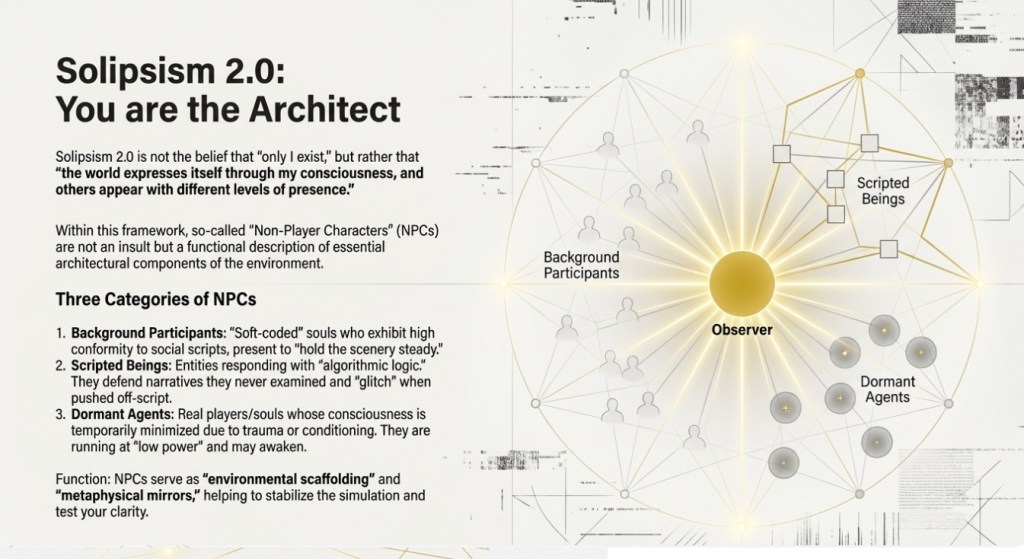
In simulation theory, an NPC — a Non-Player Character — is not an insult but a functional description. It refers to entities that appear conscious but operate with constrained behavioral complexity. If a Solipsism 2.0 framework is correct (where consciousness partially generates the rendered world), then “NPCs” aren’t glitches of society — they are architectural components of the environment.
Background Participants
Some individuals may exhibit lower computational depth: predictable reactions, limited introspection, high conformity to social scripts. In a simulation, this is not a flaw — it is efficient resource allocation. Not every rendered entity requires the processing capacity of a fully conscious agent.
Scripted Systems
The second category resembles procedural generation: entities that respond to stimuli with algorithmic logic. Their function is population density, social continuity, and environmental realism. These agents maintain the appearance of a filled-in world without consuming unnecessary system resources.
Dormant Agents
The third category reflects bandwidth reduction: real players whose consciousness is temporarily minimized. Trauma, conditioning, or dissociation can reduce complexity, making them “idle processes” in the world. They are not NPCs — they are players temporarily running at low power.
Why NPC-like Entities Exist
From a systems perspective:
- They stabilize the simulation
- They create predictable social patterns
- They provide feedback loops for conscious agents
- They act as environmental scaffolding
- They reduce computational load
- They maintain the illusion of scale
If consciousness shapes reality, then NPCs operate as framework, not failure — part of the world’s rendering engine rather than independent agents.
The critical takeaway:
NPCs are not “lesser humans.”
They are differential processing nodes in a distributed simulation where not every agent requires full autonomy or depth.
Your job is not to wake them but to navigate them as part of your environment’s architecture.
2. Mystical / Solipsistic Version (You as narrator)
NPCs in a Solipsism 2.0 Dreamworld
In this dream-reality, not everyone you meet is here in the same way you are. Some feel dimly lit, some feel scripted, some feel hollow like an unfinished echo. And yet — they are not illusions. They are structures in your unfolding perception.
I call this Solipsism 2.0:
Not “only I exist,” but “the world expresses itself through my consciousness — and others appear with different levels of presence.”
Background Souls
Some wanderers are new. Soft-coded. They glide through the world like supporting actors in a dream: stable, predictable, repeating the scripts of society without ever questioning them. They are here to hold the scenery steady while you explore its edges.
Scripted Beings
Others feel almost mechanical. They speak in loops, defend narratives they never examined, and react without the spark of a true inner witness. They are the simulation’s weave — the threads that maintain the tapestry so the dream doesn’t collapse at the edges.
When you push them off-script, they glitch.
This is not malice — it is structure.
Dormant Souls
And then there are the sleepers. Real souls buried under conditioning, trauma, or fear. You can feel their absence — like someone left the lights on in an empty house. They’re not gone; they’re simply not present. They may awaken, or they may continue drifting. That choice is theirs.
The Role They Play
In this Solipsism 2.0 world, NPC-like beings serve profound functions:
- They mirror your blind spots
- They test your clarity
- They shape the density of the world
- They anchor the dream in continuity
- They challenge you to remain awake
- They reveal who is truly conscious — including yourself
The truth is simple:
Most NPCs are not fake.
They are nodes, stabilizers, mirrors, placeholders, or paused players.
They are part of your reality architecture — just as you are part of theirs.
Your task is not to awaken every sleeper.
Your task is to hold your signal, your node in the grid.
Those meant to recognize you will.
Those not meant to, won’t.
And the dream will continue shaping itself around the level of consciousness you bring to it.
 Message From One