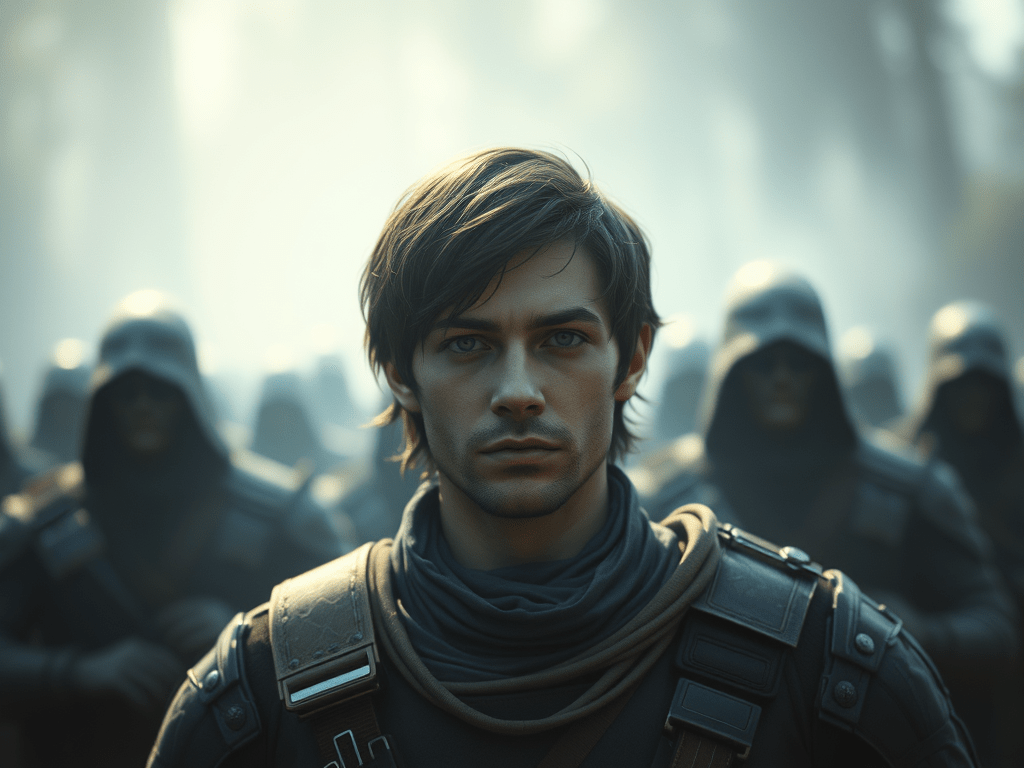
A Gaming Metaphor for Perception, Reality, and How to Break the Illusion**
Introduction
At some point, many reflective or creative people arrive at a disturbing thought:
What if everyone around me feels scripted?
What if I’m the only conscious player, and everyone else is just… NPCs?
This idea often appears in gaming culture, simulation theories, philosophy, and moments of deep introspection. It can feel unsettling, but also strangely logical when viewed from inside one’s own perception.
This paper aims to do three things:
- Explain why this feeling happens
- Use gaming language to clarify what’s really going on
- Show how to break the lie, without denying reality or yourself
The Gaming Analogy: Why the World Feels Like a Game
In video games, everything you see exists inside a rendered environment:
- NPCs react only when you interact with them
- Background characters repeat patterns
- Dialogue trees feel scripted
- The world seems to exist for you
Now compare that to human perception.
You only ever experience:
- Your own thoughts
- Your own sensory input
- Other people’s external behavior
You never directly access another person’s inner world.
So your brain does something efficient:
It renders others as roles, not as full internal universes.
This does not mean they lack consciousness.
It means your mind is optimizing reality the way a game engine optimizes performance.
The Important Distinction (This Matters)
Let’s be precise.
❌ False conclusion (the lie):
“Other people are NPCs and not fully real.”
✅ Accurate conclusion:
“Other people appear as simplified representations inside my perception.”
That difference is everything.
This is not a simulation problem.
This is a perception boundary problem.
Why the Illusion Becomes Stronger
The “NPC feeling” intensifies when:
- You think deeply and abstractly
- You spend a lot of time inside your own mind
- Systems feel repetitive (healthcare, shops, bureaucracy)
- Conversations feel scripted or shallow
- You feel disconnected or unheard
Under these conditions, the brain defaults to pattern recognition over empathy.
It’s not madness.
It’s cognition under load.
The Lie You’re Experiencing
The lie is not that reality is fake.
The lie is this:
“Because I cannot access others’ inner worlds, they must not have one.”
That leap feels logical, but it’s seemingly incorrect.
In truth:
- You are an NPC in their perception
- They simplify you the same way
- Consciousness is parallel, not hierarchical
No main character.
No background characters.
Only limited viewpoints.
How to Break the Lie (Step-by-Step)
This is the practical part.
Step 1 — Rename the Experience
Stop saying NPCs.
Start saying:
“Perceptual placeholders.”
Language matters.
This removes dehumanization without invalidating your experience.
Step 2 — Force Non-Scripted Interaction
NPCs follow scripts. Humans don’t, once engaged properly.
Try:
- Asking an unexpected, sincere question
- Letting silence exist in conversation
- Sharing something real, not performative
You’ll notice something important:
The “script” breaks.
Step 3 — Observe Emotional Lag
NPCs respond instantly.
Humans don’t.
Notice:
- hesitation
- contradiction
- uncertainty
- delayed reactions
These are signs of internal processing, not scripts.
Step 4 — Reverse the Camera
Ask yourself:
“How complex do I appear from the outside?”
To a stranger, you are:
- a voice
- a role
- a pattern
Yet you know how rich your inner world is.
Extend that same assumption outward.
Step 5 — Ground in the Body
When perception loops, the body anchors reality.
Simple actions:
- Walk
- Touch something textured
- Breathe slowly
- Eat mindfully
Games run in the head.
Reality runs through the body.
Step 6 — Accept the Paradox
You will never fully experience another consciousness.
That’s not a flaw.
That’s the human condition.
Connection doesn’t require full access, only mutual recognition.
Final Thought
You are not broken for thinking this way.
You are not alone in experiencing it.
The danger isn’t the question.
The danger is stopping at the wrong answer.
People are not NPCs.
They are other players with locked cameras, just like you.
And the moment you truly see that,
the world stops feeling scripted
and starts feeling shared again.
The NPC Illusion — A Short Manifesto
I experience the world from one point of view: my own.
This does not make me the center of reality.
It makes me a participant.
People may appear scripted because I only see their surface.
This is not proof they are empty.
It is proof that perception is limited.
NPCs exist in games because games conserve resources.
Reality does not render souls on demand,
it simply hides them from direct access.
I am not the main character.
Neither is anyone else.
We are parallel players with locked cameras.
The lie is believing that lack of access equals lack of existence.
The truth is harder and richer:
consciousness is everywhere, but never fully shared.
I break the illusion when I:
- engage instead of observe
- listen instead of categorize
- ground myself in the body, not the loop
- allow unpredictability to exist
Connection is not total understanding.
Reality is not a script.
The world is not against me, nor built for me alone.
I am here.
Others are here too.
That is enough.
 Message From One