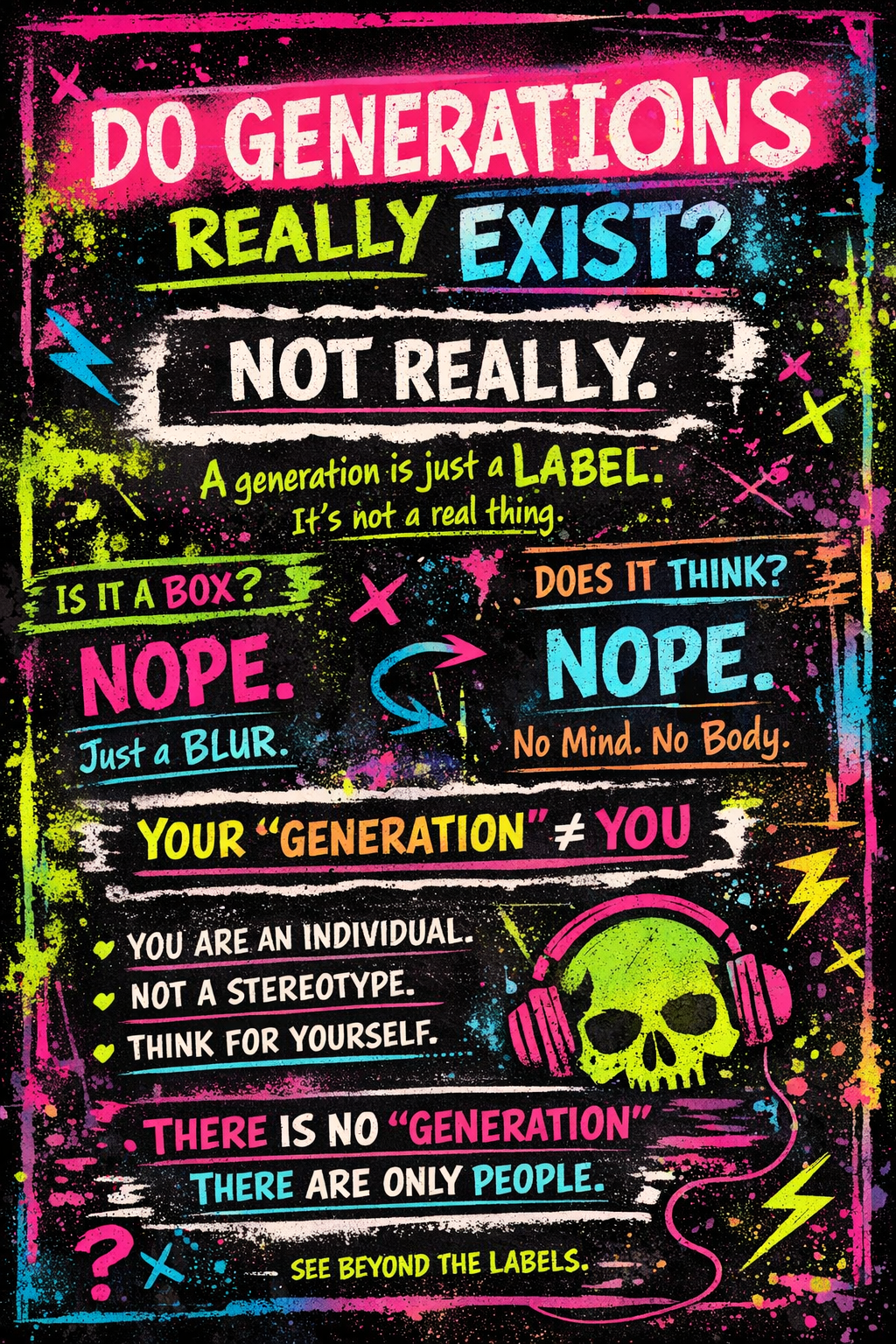
People talk a lot about generations.
“Your generation is lazy.”
“My generation had it harder.”
“Gen Z thinks differently.”
But let’s slow down for a second and ask a simple question:
Does a generation actually exist?
The short answer: no.
At least, not in the way people talk about it.
A generation is not a thing you can point at.
You can’t touch it.
You can’t measure it exactly.
You can’t draw a clear line where one generation ends and another begins.
There is no moment in time where someone says:
“Congratulations, you are now officially part of a new generation.”
What a “generation” really is
A generation is just a label.
A shortcut.
A story we tell to make the world easier to explain.
It groups millions of very different people together and pretends they are the same:
- same mindset
- same values
- same behavior
But that’s never true.
Two people born in the same year can live completely different lives, grow up with different fears, different music, different internet, different parents, different money problems. Calling them part of the same “generation” doesn’t magically connect them.
So why do people use the word?
Because it’s convenient.
It helps journalists write headlines.
It helps marketers sell stuff.
It helps adults complain about younger people.
It helps younger people blame older ones.
“Generations” are easy enemies.
And easy excuses.
Metaphysically speaking (don’t worry, this is simple)
From a deeper point of view, only individual people exist.
You exist.
I exist.
Each person has their own body, brain, and experiences.
A generation has:
- no body
- no brain
- no shared consciousness
So metaphysically?
It’s not real.
Unless… you think in quantum terms
And this is where it gets interesting.
If a generation exists at all, it’s not like a solid object.
It’s more like:
- a cloud
- an overlap
- a probability field
People born around the same time are influenced by similar events, tech, and culture, but never in the same way, never equally, never fully.
So a generation isn’t a box. It’s a blur.
Why this matters
Because when we believe too much in “generations”:
- we stop seeing people as individuals
- we replace listening with stereotypes
- we argue with labels instead of humans
“You’re just Gen Z.”
“You boomers don’t get it.”
That’s not understanding.
That’s intellectual laziness.
Final thought
A generation is not something that exists.
It’s something we use.
And like all tools, it can help, or it can distort reality.
So next time someone says, “Your generation is the problem,”
remember:
There is no generation. There are only people.
And people are always more complex than the stories we tell about them.
 Message From One