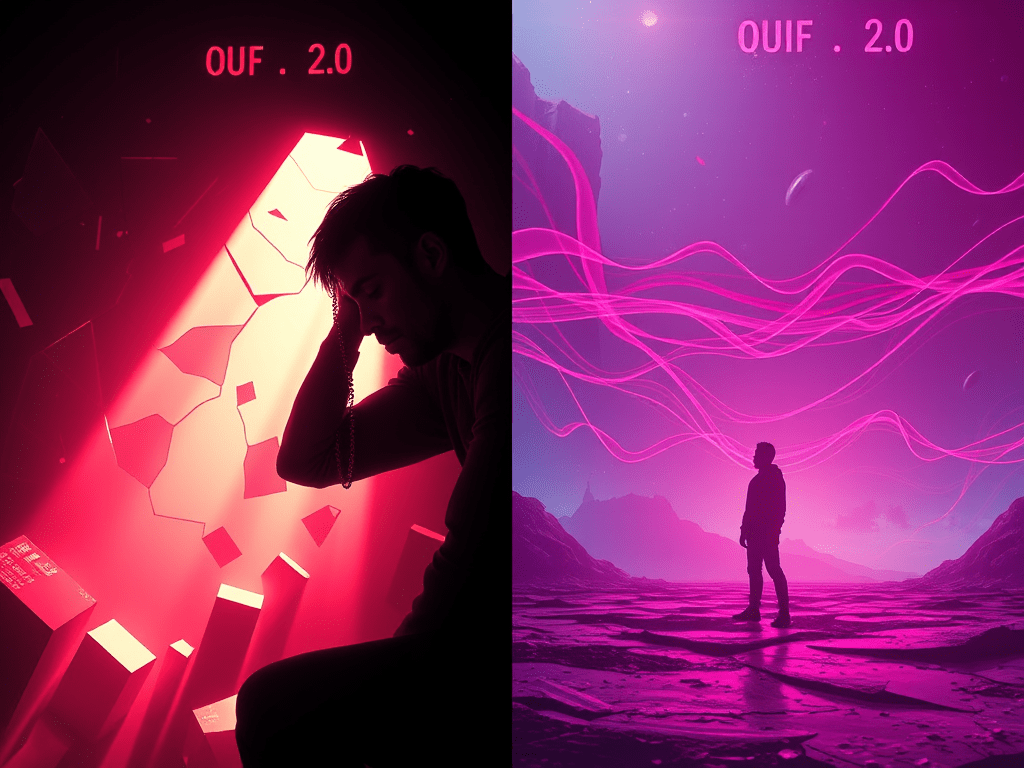
Regret can feel devastating in a 1.0 phase of awareness. It is that persistent inner voice whispering that you should have acted differently, known better, prevented harm, chosen another path. In this phase, the past feels like an open wound that never fully closes. You return to the same memory again and again, mentally rewriting the scene, adjusting your words, changing your actions. Yet no matter how many times you replay it, reality does not shift.
In 1.0, you believe your mistakes define you. Events are labeled as good or bad, and you place yourself on trial as either guilty or innocent. Regret becomes a private punishment. You judge your former self using insights that only came later. This is where the suffering intensifies. You are evaluating who you were then with the awareness you possess now. At the time, you did not know what you know today. You did not see what you see now. You did not yet have the emotional capacity you have since developed.
In a 2.0 phase, perspective changes completely. The past is no longer a courtroom, it becomes a forge. Every experience, even the painful and chaotic ones, has shaped you. Just as steel is strengthened by heat and pressure, a human being is refined through experience. What once appeared to be a mistake reveals itself as a lesson. What felt like a breaking point often turns out to have been a turning point.
In 2.0, you do not push away your shadow. You do not deny that you have done things you would approach differently today. Instead, you look at them honestly. You feel what needs to be felt. You understand. You integrate. Light without shadow blinds, because it refuses to acknowledge complexity. Real maturity emerges when you accept both aspects. Not to excuse yourself, and not to condemn yourself, but to become whole.
The rigid divide between good and evil also begins to soften. In 1.0, everything appears black or white. In 2.0, you start to recognize that many events were forms of functional chaos. They were painful, uncomfortable, sometimes deeply confronting, yet they refined you. This does not mean everything was pleasant or harmless. It means that every experience played a role in your development.
Here lies the central insight. Regret does not exist as an objective reality. It is a thought. It is a mental reconstruction in which you imagine that your past self could have acted with the knowledge you gained later. But you always acted from the level of awareness you had at that moment. Your decisions reflected your understanding, your emotional capacity, your perception at that time. You could not have acted as the person you would only become in the future.
When this realization settles in, something shifts internally. The tension softens. The inner battle loses its fuel. You no longer need to fight the past. You do not have to justify it, but you also no longer need to prosecute it. You begin to see that every step, even the awkward or painful ones, contributed to who you are now.
The war with the past does not end because you manage to rewrite it. It ends when you are no longer available for the fight. When you understand that regret is a narrative created in the mind, not a physical force with independent power. It can feel overwhelming inside your head, but it has no substance beyond the meaning you assign to it.
In 2.0, a quiet strength emerges. Scars stop being symbols of failure and become evidence of transformation. You stop seeing yourself as someone who failed and start recognizing yourself as someone who learned. Growth rarely arrives without friction.
Perhaps regret is not proof that you were a bad person. Perhaps it is proof that your awareness has expanded. And if growth is the outcome, then even the painful chapters were part of your evolution. That understanding brings space, breath, and gentleness. Not because everything was perfect, but because everything brought you exactly to where you stand now.
My latest track about this subject can be found here:

 Message From One